RG Richardson Business & Economics

RG Richardson Business & Economics
Interactive financial ebooks

A Racist Group Is Trying to Gain Legitimacy in Canadian Politics

A Racist Group Is Trying to Gain Legitimacy in Canadian Politics
The Dominion Society is part of an international far-right movement proposing mass deportations.

Rachel Gilmore TodayThe Tyee

Rachel Gilmore is an award-winning journalist with extensive experience reporting on federal politics, human rights, disinformation and extremism.Our journalism is supported by readers like you. Click here to support The Tyee.

SHARE:


46

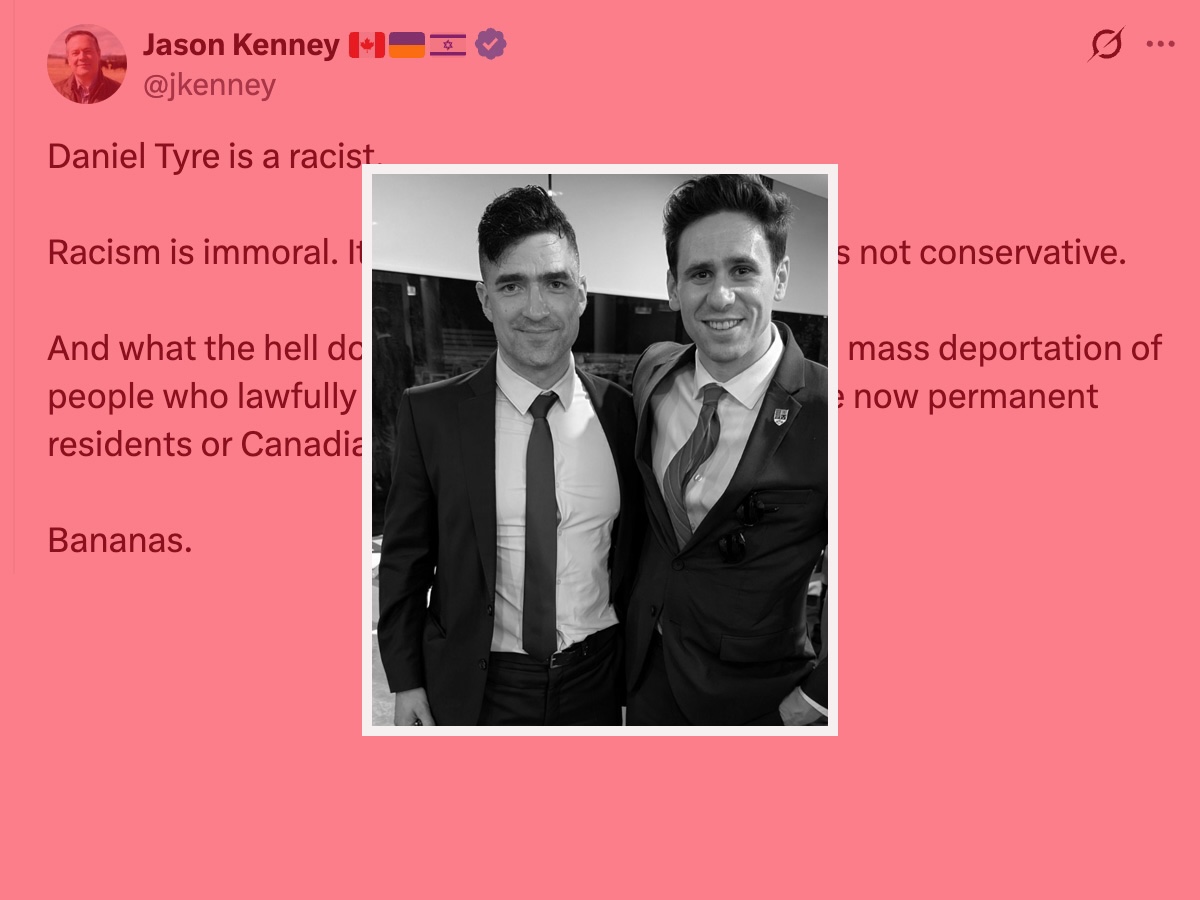
Daniel Tyrie, right, stands beside Martin Sellner at a ‘remigration’ conference in Portugal in May. Illustration by Tyee staff. Photo and Jason Kenney post via X.


Listen to this article
15 min


As Pierre Poilievre stepped onto the stage to address the Canada Strong and Free Network conference in early May, some of the most prominent and important establishment conservatives in Canada were looking on.

Announcements, Events & more from Tyee and select partners
Do You Believe There’s Still a Job for Human Journalists to Do?

Only if the humans who read them support them. And here comes AI.
CONTEST: Win Tickets to See Isaiah Collier Live

The acclaimed saxophonist will give a July jazz festival performance at the Vancouver Playhouse.

So too was an increasingly notorious “Canadian nationalist” who advocates for the mass deportation of those he deems “foreigners” — which includes permanent residents and birthright citizens — from the country: Daniel Tyrie.

For Tyrie, attending the conference was part of “an important strategy”: one of humanizing his organization — and its ideas — in the eyes of some of the most powerful right-wingers in Canada.

Tyrie is the executive director of the Dominion Society of Canada, a group that advocates for a far-right policy known as “remigration.” The Dominion Society is proposing to remove up to nine million people — as much as 21 per cent of Canada’s current population — by deporting immigrants as well as revoking birthright citizenship.

The racist idea has become increasingly mainstream around the world in recent years, thanks to far-right European politicians and U.S. President Donald Trump’s White House. The concept has gained enough international support that its far-right proponents gathered in Porto, Portugal, in late May for a “Remigration Summit.”

The Tyee is supported by readers like you Join us and grow independent media in Canada


Hundreds, including Tyrie, attended.

Researchers have called the remigration movement a form of ethnic cleansing, a parallel Tyrie denies. He’s also denied being a white nationalist. Despite his protestations, however, Tyrie has said in interviews that he’s “very clear about what a Canadian is.”

“All these groups that established Canada, this ethnic continuity that we’re talking about, these people can be called white people,” he said in a February interview with Candice Malcolm of Juno News.

Now, Tyrie says he’s hoping to use events like the Canada Strong and Free Network conference to normalize his ideas in Canadian politics.

“I’m just going to take a chance to get to talk to these people, to humanize the organization, because so many of these people, they think we’re, like, radical, unreasonable,” he told supporters on a May 7 livestream, the day he saw Poilievre speak at the conference.

Tyrie grinned as he acknowledged some of his online followers can be “feral,” which has led some to be “apprehensive” of him in these rooms.

“But it’s good to show up and be there in person, show face, have conversations with people and show them that we’re serious, we’re professional, we’re reasonable, we’re not going to back down on our ideas but we can actually work collaboratively with people, that we’re not just hateful, radical bigots,” he said.

“That we understand how the process works and our role in the greater system.”

According to Tyrie’s telling of the conference, some conservatives were buying what he was selling.

“But there have been some interesting people — some interesting, very nice people in and around political parties and other groups, media and so on — that have taken some time to talk with me, get to know me, get to know our ideas,” Tyrie boasted.

“In that sense, I think it’s been rather productive.”

That’s exactly why researchers who study the far right are voicing their concern that Tyrie was allowed to be in such a powerful room.

“The inclusion of remigration activists such as Daniel Tyrie into mainstream conservative spaces is unacceptable,” said Wendy Via, CEO and co-founder of the Global Project Against Hate and Extremism.

What is remigration?

“Remigration is at its core a call for ethnic cleansing of non-white people from a country,” Via told The Tyee in a statement.

The term was popularized by Martin Sellner, whom Via described as a “European former neo-Nazi” and the “de facto leader of the white nationalist Identitarian movement.” Austrian author Natascha Strobl, who wrote a book about Sellner’s Generation Identity movement, researched Sellner’s background and has said he was part of the “neo-Nazi scene” as a teenager.

On its website, the Dominion Society tells the public that to understand remigration, “you must first understand the great replacement.”

That is the baseless theory that white people are being deliberately “replaced” by a cabal through migration and growing minority communities. While different adherents to this racist conspiracy theory pin the blame on different groups for supposedly spearheading this “replacement,” Jewish people are often blamed for the supposed “plot.”

While the Dominion Society website makes no mention of Jewish people, it does assert that “the great replacement” is “not a conspiracy theory.”

“Heritage Canadians are being replaced — and it’s happening all over the world,” its website reads.

The solution to this, according to the group, is “remigration.”

Remigration, as a concept, is packaged to appear “reasonable to the average person,” the Canadian Anti-Hate Network wrote in an explainer piece on the issue.

It’s this packaging that makes the idea so insidious. It allows a white nationalist concept to move from the fringes into the mainstream — including into politics.

In Germany, the far-right Alternative for Germany party, known by the abbreviation AfD, has embraced remigration. In November 2023, AfD politicians and aides joined neo-Nazis in a secret meeting with Sellner, in which he reportedly outlined his remigration proposal.

In early January 2025, AfD leader Alice Weidel publicly embraced the term. Speaking to a conference hall about “large-scale repatriations,” she affirmed that “if it’s going to be called remigration, then that’s what it’s going to be: remigration.”

Meanwhile, the Trump White House is also now using the term. The Department of Homeland Security has posted the message “Remigration now” on social media. The State Department has also proposed the establishment of an “office of remigration.”

Just weeks ago, on May 12, the White House posted a graphic with a red line striking out the words “replacement migration.” Below, in larger type and notably absent any strikeout, was the word “remigration.”

Now, proponents of this racist movement want it to enter the mainstream in Canadian politics — and they’re networking domestically and internationally to work towards that goal.

Canadian group attends ‘Remigration Summit’ in Portugal

In late May, Tyrie and his fellow Dominion Society leaders travelled to Portugal to join hundreds of far-right figures and supporters attending a “Remigration Summit” — one that was co-organized by Sellner.

Smiling alongside Sellner in a photo the two took at the summit, Tyrie gushed in an X post about his admiration for the figure.

“It was a great pleasure to finally have the chance to meet [Martin Sellner] in the flesh. Martin is the Godfather of the Remigration movement. No one has done more to advance the cause not only in his home country, but across Europe and the Western world,” Tyrie wrote.

“Martin has been a key influence on me as we have built the strategy and tactics behind the [Dominion Society] in order to advance remigration in Canada. It was very motivating to hear that our young movement is measuring up to his ambitious standards.”

Sellner shared the post, adding, “The honour and pleasure was mine.”

“I’ve been watching your impressive work for a while, and we’re looking forward to increasing the connection and collaboration with Canada’s Identitarian Movement,” Sellner wrote.

Tyrie spoke at the conference, as did many international far-right figures. Wired’s David Gilbert reported also seeing members of Patriot Front, a U.S. white supremacist group, at the event.

Gregory Bovino, the U.S. Border Patrol “commander at large” who spearheaded Trump’s deadly immigration crackdown in Minneapolis and other cities, was a star speaker at the conference.

He reportedly told the crowd that remigration is “the most important topic of our lifetimes.”

“Use us. Many of you have my phone number. I am a phone call away, and I would absolutely love to ensure that those lessons are not learnt a second time,” Bovino told the crowd, according to Wired.

Tyrie is among those claiming to have Bovino’s phone number. When a user on X asked whether Tyrie met with Bovino, the Dominion Society leader replied, “Of course.”

“Have his number for when we need to start rounding them up,” Tyrie added.

Apparently for Tyrie, showing up in spaces like the Canada Strong and Free Network conference is part of how he plans to work towards that goal of “rounding them up.”

How did a ‘Canadian nationalist’ attend a conservative conference?

The Canada Strong and Free Network conference Tyrie attended featured several high-profile politicians this year, in addition to Poilievre.

Alberta Premier Danielle Smith and Trump’s former secretary of state, Mike Pompeo, were also speakers at the conference, alongside several former premiers, current members of Parliament and darlings of right-wing media.

But getting into that powerful room isn’t cheap — and you can’t do it anonymously. A general admission ticket will run you over $500. VIP tickets cost more than $2,000, and even a student ticket is more than $250.

The sign-up process, which The Tyee verified, requires the attendee to provide plenty of identifying information, including their full name, address, postal code and contact information.

That means the organizers, who are responsible for the safety and cohesion of a room of some of the country’s most prominent conservatives, would have the names of all attendees.

Despite this, Tyrie wasn’t prevented from attending — something that surprised him.

“I wasn’t sure if they’d even let me in,” Tyrie told his supporters on the May 7 livestream.

According to Tyrie’s telling of events, the organizers were sufficiently aware of his attendance to have him monitored — but not removed.

“I have been allowed to attend. I haven’t been bothered too much,” he told his livestream.

“Actually, they did have a security guard following me around and filming me and taking pictures today, so I thought that was a bit odd. But I’m just going as an attendee.”

The Tyee contacted the organizers of the Canada Strong and Free Network conference to provide comment for this story, but we did not receive a reply.

According to Via, the people who organized this conference failed when they allowed Tyrie to march through the conference venue doors.

“Mainstream conservative spaces must not fall for the white nationalist strategy of ‘humanizing’ their calls for ethnic cleansing, and instead institute proper vetting processes to filter out hate from their political discourse,” she said.

“Anything else simply normalizes a racist term and idea that has no place in serious immigration policy discussions.”

Are conservatives buying into these ideas?

Tyrie told his supporters the goal was to show attendees he — and his ideas — are reasonable. He claimed that some at the conference were “making eye contact,” then “quickly looking away, trying to avoid” him.

But others, he boasted, did hear him out.

“I won’t go and ‘out’ the people that have been nice enough to actually talk with me,” he told the livestream.

The mass deportation enthusiast has had a mixed reception in Canada’s conservative circles.

Prominent right-wing websites like Juno News have repeatedly platformed Tyrie, publishing his opinion pieces and even holding a “debate” between Tyrie and Juno News founder Candice Malcolm on the topic of immigration.

In the interview, Tyrie appeared to be using the same strategy he described deploying at the Canada Strong and Free Network conference: he watered down the true nature of his beliefs, though he still found time to make it clear he views the “ethnic continuity” of Canada to be that of “white people.”

That prompted vocal criticism from a prominent conservative: former Alberta premier Jason Kenney.

“Daniel Tyre is a racist. Racism is immoral. It is poison. It is not ‘vitality.’ It is not conservative,” Kenney wrote on X on Feb. 16.

“And what the hell does ‘remigration’ mean? Forced mass deportation of people who lawfully immigrated to Canada, and are now permanent residents or Canadian citizens? Bananas.”

Malcolm pushed back, defending the decision to platform Tyrie.

“It isn’t racist to want to end mass migration,” she responded, massively downplaying what the concept of ‘remigration’ actually calls for.

“It isn’t racist to define what it means to be Canadian. And it isn’t racist to say that those who don’t belong in Canada should be asked to leave.”

Tyrie, meanwhile, was thrilled to have defenders in the right-wing media outlet — which has also repeatedly interviewed some of the most prominent Conservative party figures, including Poilievre.

“Big ups to the team at Juno,” Tyrie said on a livestream at the time.

“That’s exactly what we need from the counter-narrative space. So I really want to give a shout out to those guys.”

Carmen Celestini is a lecturer at the University of Waterloo who studies religion, extremism, conspiracy theories and politics in North America.

She said Tyrie’s decisions to show up in right-wing spaces is indeed “an important strategy.”

“Daniel Tyrie, in one of his podcast interviews when the society first started, said their plan was metapolitics,” she told the Tyee.
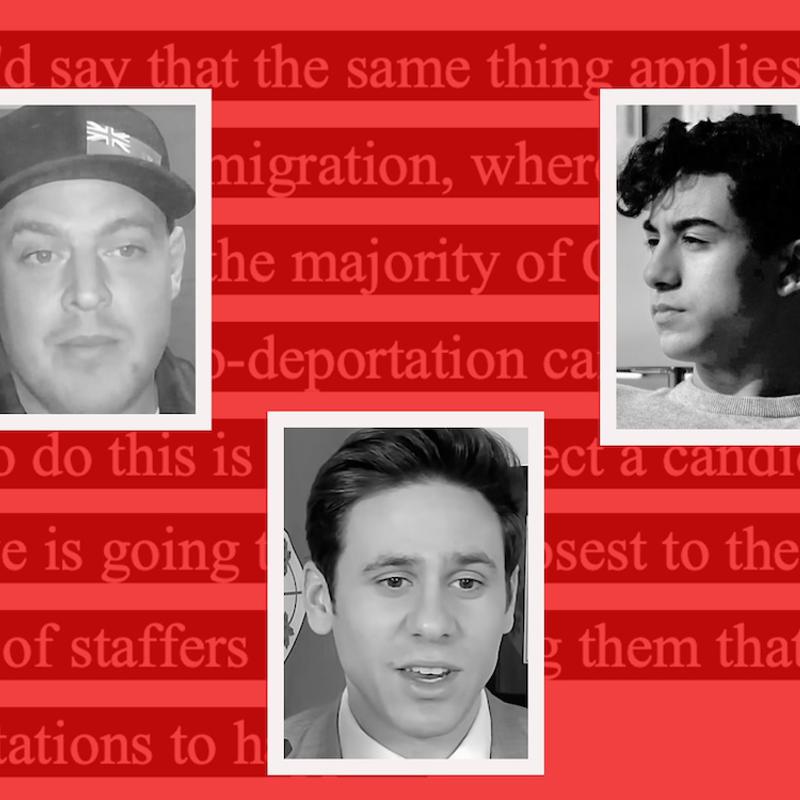


Inside the Far-Right Push to Influence Canadian Political Partiesread more

“They want to infiltrate the main parties with their volunteers to make it look like this is the majority opinion. Then the parties would have to come to him for white papers on how to implement their remigration plan.”

She said their plan is to “activate the youth and force the change they want.”

Despite their big plans, it’s clear the Dominion Society’s ideas can still be staved off from truly entering mainstream political debate.

When Tyrie spoke at the “Remigration Summit,” he lamented that Canada’s “migration situation is very advanced.”

“It’s very dire. But the political situation is so far behind,” he said, according to a video and transcript of the panel provided to The Tyee by the Global Project Against Hate and Extremism.

Tyrie finished his remarks on the panel with what was likely intended as a battle cry.

“All we need to do is to get organized,” Tyrie said, “and our victory is inevitable.”

For Canadians who oppose Tyrie’s cruel agenda, however, it should serve as a hopeful reminder as much as a warning: his ideology has yet to take hold in the minds of many Canadians — and that means, despite his confidence, it can be uprooted.

This article is part of The Tyee’s reader-funded Reality Check project exposing and explaining disinformation.
Mark Zuckerberg Used Shell Companies to Bully Native Hawaiians

 Mark Zuckerberg Used Shell Companies to Bully Native Hawaiians


Futurism · 10 minutes ago
by Joe Wilkins · Future Society


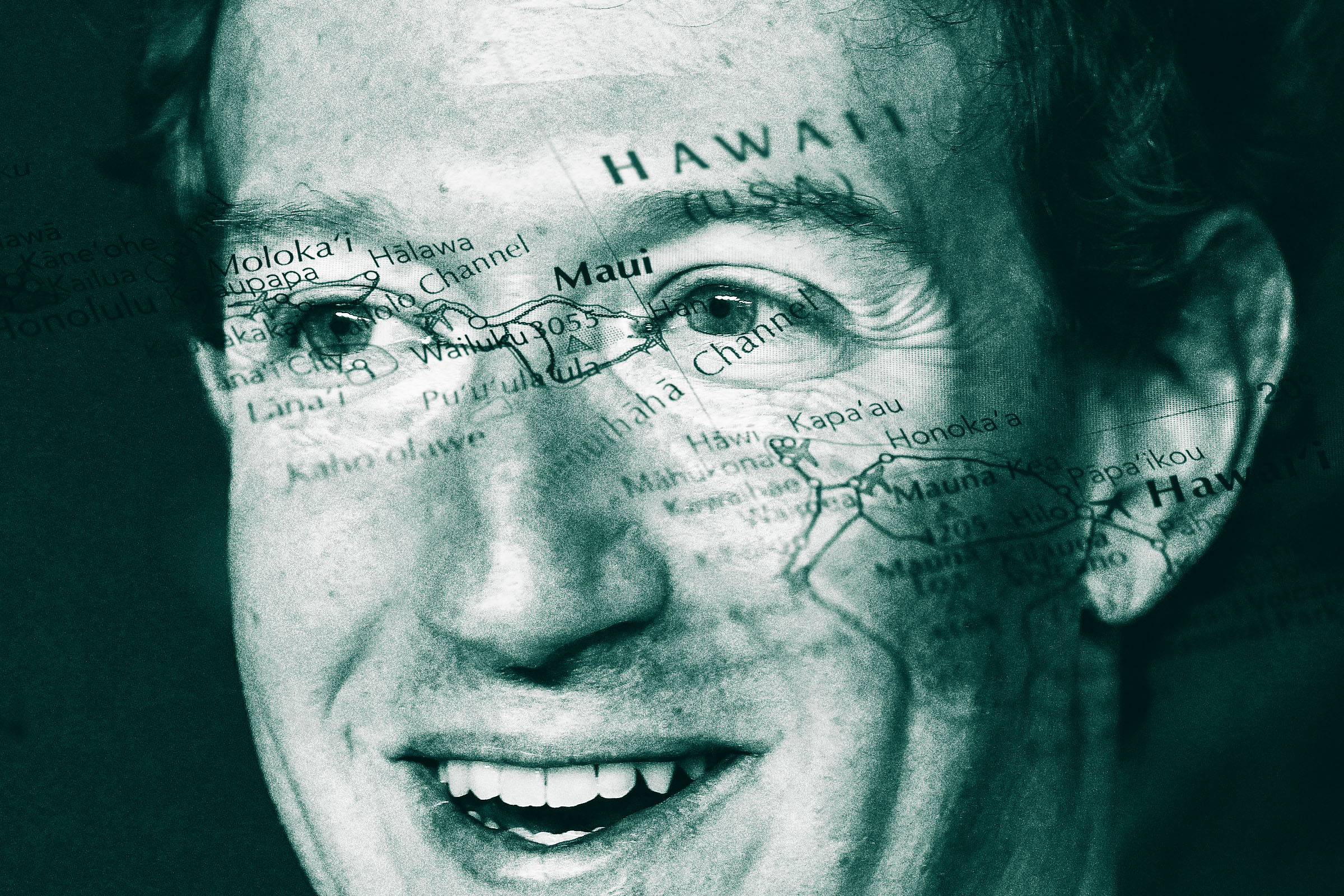
Currently ranked as the sixth richest person on Earth, it should come as no surprise that Mark Zuckerberg is hoovering up valuable real estate like a feudal lord after a plague. What is surprising is how he’s gone about securing his acreage, and who he’s snatching it from.

Starting in 2014, the Facebook co-founder set about acquiring land on the Hawaiian island of Kaua’i one parcel at a time. According to the latest reporting on his land acquisitions, reported by Wired in 2025, Zuckerberg now owns $311 million worth of land on Kaua’i, weighing in at over 2,300 acres — roughly three times the size of New York City’s iconic Central Park, for scale.

He’s accomplishing that with a careful amalgamation of Hawaiian-sounding shell companies, through which he’s sued hundreds of descendants of Native Hawaiian land owners, per HR News. These lawsuits first made waves in 2017, when it was reported that Zuckerberg was suing over 100 families for the right to bid on just eight combined acres of family-held land.

Many of Zuckerberg’s lawsuits targeted owners of kuleana lands, small tracts of lands originally granted to Native Hawaiians in an 1850 decree. As precious family heirlooms, the rights to these plots have been passed down for generations, and are meant to stay with the descendants of the original Hawaiian owners.

Unfortunately, the records of those long-held property rights haven’t always been maintained, because prior to colonization, Native Hawaiians “did not conceive land as exclusive and alienable, but as communal and shared,” as Hawaiian law scholar Melody Kapilialoha MacKenzie explained in a 2011 research paper.

This means that identifying the individual owner of a kuleana parcel can be difficult, as many Hawaiian descendants have inherited the land title over the past 176 years.

As real estate attorney Loren Barr explained in a recent blog post, Zuckerberg has tried to force his way through these centuries-old land practices by filing scores of Quiet Title actions against their owners. Per Barr, these types of legal actions are taken “when the ownership of a property is unclear or when there are numerous claimants to the title.” Basically, if two or more property owners are fighting over who owns a property, a quiet title lawsuit can force contested property into auction, where the highest bidder wins the deed.

Given Zuckerberg’s vast financial wealth, it’s safe to say few individuals could ever compete with him in an auction. Though he ended up dropping his 2017 lawsuits after significant backlash from locals, his acquisitions have continued, though now with a veil of secrecy. Understandably, his ongoing land-grab has drawn sharp criticism online, where netizens seem ready to construct the proverbial guillotine.

“I’ve never hoped for a volcano to become active again before but here we are,” one poster on Reddit mused, referring to the long-extinct Kaua’i volcano.

“And Larry Ellison owns the entire island of Lanai,” another Redditor correctly observed (that tech billionaire owns 98 percent of Lāna’i’s total acreage.) “These f**king oligarchs need to be taken down a peg.”

More on Zuckerberg: Mark Zuckerberg Is Realizing That When You Treat Your Workers Like Human Garbage, They Might Not Like You Anymore

The post Mark Zuckerberg Used Shell Companies to Bully Native Hawaiians appeared first on Futurism.

We’re relentlessly focused on lowering costs for Canadians


Liberal Party of Canada
---

Facebook is paying people overseas promoting Alberta separatism | CBC Music

Facebook is paying people overseas promoting Alberta separatism | CBC Music

Facebook is paying people overseas promoting Alberta separatism
CBC uncovers 14 accounts from India, Pakistan, Indonesia posting on popular Alberta separatist groups


Eric Szeto, Jordan Pearson, Christian Paas-Lang · CBC News · Posted: Jun 08, 2026 1:00 AM PDT | Last Updated: 10 hours ago


Listen to this article
Estimated 8 minutes

A CBC News investigation found a number of Facebook accounts run by people overseas impersonating real Albertan separatists. (Illustration: Froilan Untalasco/CBC; Nieta Aqila/Facebook)

Social Sharing


You might think, based on the volume of her Facebook posts, that Nieta Aqila is an Albertan who supports separation.

"I signed the Alberta independence petition" because "Canada is not a great country anymore," an account in her name wrote in a popular Facebook group called Alberta Independence that promotes the movement and has more than 100,000 members.

In another post, Aqila said she was harassed and had rocks thrown at her as she canvassed for petition signatures.

The account's posts have generated thousands of reactions, comments and shares in recent months as the issue heated up.
WATCH | Investigating overseas accounts in Alberta separatism groups:


Facebook is paying people overseas promoting Alberta separatism
10 hours ago|
Duration5:04CBC’s visual investigations team takes you inside the overseas industry profiting from Alberta separatism. We find more than a dozen overseas accounts posting in the most popular separatist Facebook groups; in some cases, they steal content from real Albertans and brag about making money via Meta’s monetization program.

But the account owner, according to a CBC visual investigation, was posing as a Canadian and is actually a noodle merchant and content creator from Indonesia, who in some cases was just stealing content from real Albertans.

One example of a post Nieta Aqila stole from another user. In the left photo, on April 2, Edmonton resident Brock Ireland posted about canvassing for the movement on Facebook. On the right, on April 3, Aqila used the exact text and photos. (Illustration: Froilan Untalasco/CBC; CBC, Brock Ireland/Facebook, Nieta Aqila/Facebook)

When contacted by CBC, one Albertan whose content was stolen said they felt "absolutely violated."

Nieta Aqila even posted about income she generates from Meta's monetization program, which rewards creators for engagement and solicits subscribers on her personal page.

Nieta Aqila wrote on Facebook that ‘Canada is not a great country anymore.’ CBC found she was pretending to be a Canadian supporting the movement in various Facebook separatists groups. (Illustration: Froilan Untalasco/CBC; Nieta Aqila/Facebook)

Nieta Aqila is among 14 overseas accounts CBC identified in four popular Alberta independence Facebook groups. The accounts have posted politically divisive content about Alberta separatism, Western annexation and other hot-button Canadian topics within the past two months.

Many of them — which Facebook indicates are run from Indonesia, Pakistan, India, the U.S. and Sri Lanka — are top contributors to Alberta-focused pages and have cumulatively garnered tens of thousands of reactions and comments in posts and cross-posts across more than a dozen Facebook groups. Two users posted images of the money they make from Facebook.

The inauthentic accounts identified by CBC were top contributors to many separatist groups. (Illustration: Froilan Untalasco/CBC; Alberta Separatist Movement/Facebook, Alberta Independence/Facebook, Riri Seyer/Facebook)

Multiple experts told CBC that the findings show how Facebook's incentives for creators can harm public discourse around important topics.

"This may not always be classic foreign interference in the state-backed sense. Sometimes it's much more banal. It's in some ways more depressing," said Matt Navarra, a social media consultant in the U.K. whose clients have included Meta and Google.

"People sitting thousands of miles away working out that Canadian outrage is a profitable niche. I think they may not actually care about Canadian politics at all."

Nieta Aqila is a noodle merchant in Indonesia, not an Albertan as she posted in the Alberta Independence Facebook group. (Nita Evin/Facebook)

While it's difficult to determine the level of real-world influence these posts have, they elicited strong reactions from some users.

"Lock and load Albertans!" wrote one commenter on an image with the text "Mark Carney can't block Alberta Independence."

Posts from overseas accounts would sometimes get strong reactions from people online. In this case, one person wrote, ‘Lock and load Albertans!’ (Illustration: Froilan Untalasco/CBC; Alberta Independence Movement/Facebook)

In another example, one person wrote that 'there was a time when traitors were executed,' in response to an Alberta separatist post made by overseas accounts. (Alberta Independence Movement/Facebook)
'I feel absolutely violated'

As Alberta debates holding a referendum on whether the province should leave Canada, passion from real Albertans has been evident online — but so has a cottage industry built around exploiting the topic.

For example, a CBC visual investigation recently found that several YouTube channels with tens of millions of views that promoted U.S. annexation of Alberta were created by people living in the Netherlands to generate income from the platform.

Facebook's monetization program allows for users to earn money on Reels, photos, stories and text posts. (Facebook)

Experts say it appears that a similar economic model, where monetization incentivizes content that is engaging rather than accurate or accountable, has taken off on Facebook despite rules banning deceptive content.

"There are two beneficiaries of this. One is the grifters who are monetizing. They are engaged in this activity because it is financially profitable for them," said Aengus Bridgman, director of the Media Ecosystem Observatory at McGill University in Montreal. "The other is the platform itself … the ad revenue monetization around the attention that they're getting."

Facebook groups focused on Albertan separatism are very active, with hundreds of posts a day spread across the groups; in this mix are overseas content creators.

Inauthentic accounts CBC identified often used posts generated by artificial intelligence to advocate for Alberta separatism. (Illustration: Froilan Untalasco/CBC; Alberta Separatist Movement/Facebook, Saskatchewan Separation Referendum/Facebook)

In some cases, the accounts employ deception to appear Canadian. In one post, Nieta Aqila — who has racked up more than 2,000 reactions in the Alberta Independence group — claimed to have met people who were canvassing for independence in Calgary and expressed support.

Not only did CBC find an identical post from a real Albertan made the day before, but photos posted by the Nieta Aqila account also reveal that she was in Indonesia that week — in fact, her profile reveals that she lives in the city of Palembang.

E.P.A. to Repeal Some Limits on ‘Forever Chemicals’ in Drinking Water - The New York Times

E.P.A. to Repeal Some Limits on ‘Forever Chemicals’ in Drinking Water - The New York Times


E.P.A. to End Some Limits on ‘Forever Chemicals’ in Drinking Water

The rules were established by the Biden administration after research linked the compounds to a range of serious health problems.

Listen · 9:42 min

Share full article


184

Lee Zeldin, the E.P.A. administrator, has argued that the agency made a procedural error when it established the drinking water standards in 2024.Credit...Haiyun Jiang/The New York Times


By Lisa Friedman


Reporting from Washington
May 18, 2026

See more of our coverage in your search results.Add The New York Times on Google


The Trump administration announced Monday that it will drop some limits on “forever chemicals” in drinking water that officials had determined can cause cancer and other serious health problems — angering some key activists who had supported President Trump’s campaign.

The Environmental Protection Agency said it would unravel the nation’s first federal drinking water limits for the compounds, perfluoroalkyl and polyfluoroalkyl substances, or PFAS. The Biden administration established the limits on six of the substances in 2024, after the agency determined that long-term exposure to PFAS was linked to kidney cancer, immune system suppression, developmental delays in infants and children and other issues.

Instead, the Trump administration will issue narrower regulations that rescind protections for four of the substances and continue to protect against two of them, though companies will be able to request two extra years to comply with those.

But the move, which had been planned for more than a year, has sparked fury within the Make America Healthy Again movement, a diverse group of anti-vaccine activists, wellness influencers and others who make up a key part of Mr. Trump’s coalition.


Lee Zeldin, the E.P.A. administrator, sought to counter that anger by appearing Monday with Robert F. Kennedy Jr., the health and human services secretary who spearheaded the MAHA movement, and announcing nearly $1 billion to help states address the contaminants in drinking water.

“They persist in the environment, they build up in the human body, and addressing them is not optional. It is essential to making America healthy again,” Mr. Zeldin said at an event in the wood-paneled Map Room on the first floor of the E.P.A. headquarters.

Mr. Zeldin argued that the Biden administration made procedural errors with its drinking water standards and said his E.P.A. will regulate “the right way, following the law and following the science.” He has also raised concerns that water systems could pass costs on to consumers if the compliance deadline wasn’t pushed back. The Biden administration had estimated the rule would cost about $1.5 billion to implement each year, but Congress in 2020 provided about $9 billion to improve drinking water and address chemicals like PFAS.

The Trump administration will continue to protect communities from the chemicals present in the tap water of millions of Americans, Mr. Zeldin said. He highlighted the work of companies that create technologies to capture and destroy the substances.

Mr. Kennedy insisted that the Biden administration’s drinking water standard would not have survived a court challenge, and that the Trump administration had no choice but to start the regulatory process over. Chemical manufacturers had already sued over the Biden-era standards. Both Mr. Kennedy and Mr. Zeldin suggested future protections might ultimately be stronger than the earlier rules.


“The president is completely committed to removing PFAS,” the health secretary said.

Many activists in the MAHA base have already expressed disillusionment with the Trump administration over its backing of a controversial weed killer and previous plans to delay deadlines for water utilities to limit two types of PFAS in drinking water. Some on Monday described the E.P.A.’s effort to describe their plan as positive for public health as misleading, despite more than a dozen mentions of “Make American Healthy Again” at the PFAS event.

“We have more than enough evidence to show that forever chemicals are harmful to human health,” said Kelly Ryerson, who is known as the Glyphosate Girl on social media, “I would strongly advise the E.P.A. not to move forward on deregulating PFAS if they want to win the November midterms.”

PFAS compounds are man-made and found in a wide range of consumer products including dental floss, baby bibs and fast-food wrappers. The substances help clothing and carpets resist stains and are an important ingredient in firefighting foam. But they are called forever chemicals because they also resist breaking down, lingering in the environment and accumulating in the body.

The chemicals are so ubiquitous that they can be found in the blood of almost every person in the United States. A 2023 government study of private wells and public water systems detected PFAS chemicals in nearly half the tap water in the country.

Under Mr. Zeldin’s new plan, the E.P.A. will issue two new rules. The first one will repeal limits on four types of PFAS — including what are known as GenX substances, which have contaminated a major source of drinking water in North Carolina. The E.P.A. will then restart a lengthy process to decide whether those substances should be regulated and, if so, how.

Editors’ Picks
How to Have a Difficult Conversation

Ghosts of the Gulf: The Unsung Revolutionary War Campaign

I Think Someone Is Living in the Storage Unit Next to Mine. What Should I Do?


Separately, the E.P.A. will issue a new rule to retain limits on perfluoroalkyl and polyfluoroalkyl substances, commonly referred to as PFOA and PFOS. The Biden administration’s E.P.A. concluded there are no safe levels of those substances in drinking water and limited them to 4 parts per trillion, which is the lowest level at which the substances can reliably be detected. However, water utilities will be able to request two additional years to comply, until 2031 rather than the current deadline of 2029.

Image
A warning of PFAS-contaminated water in Wisconsin. The chemicals are so ubiquitous that they can be found in the blood of almost every person in the United States.Credit...Michael Phillis/Associated Press


Chemical makers and municipal utilities had sued the E.P.A. to block all of the drinking water standards, arguing that the agency did not follow the Safe Drinking Act process or use the best data when finalizing its rule. Once the Trump administration took office, the E.P.A. asked the court to partially vacate the Biden-era regulation, but the U.S. Court of Appeals for the District of Columbia declined to do so.

A spokesman with the American Chemistry Council, a trade group that represents chemical manufacturers, declined to immediately comment and said the group is reviewing the new E.P.A. proposal.

Alexandra Muñoz, another MAHA activist and a molecular toxicologist, said she is skeptical of Mr. Zeldin’s claim that he will eventually impose protections for GenX and other compounds, given the administrator’s laser focus on eliminating regulations. The E.P.A.’s move to restart the process of considering drinking water standards for GenX and other forever chemicals effectively means the agency is agreeing with its industry critics, she said.


“What is the delay going to be now for the regulation of GenX, which is incredibly dangerous and widely used?” Dr. Muñoz asked, adding, “Why not defend this rule in court and see what the judge thinks?”

Others with MAHA were more optimistic. Lauren Winn, who co-founded a group called the Womens’ Health Assembly, said she is confident Mr. Zeldin and Mr. Kennedy will keep their promises to regulate the four PFAS chemicals again.

“They are going to do it,” Ms. Winn said, adding, “They care so much. They’re not your stereotypical Republicans who want only deregulation. What they want to do is build it back the right way.”

Water utility associations said the costs so far were more than double the Biden administration’s estimates, and, combined with mandates to replace lead pipes, will raise residents’ water bills even when counting the $9 billion from Congress.

Utilities also have won multimillion-dollar settlements against PFAS polluters. The $1 billion that Mr. Zeldin announced for states on Monday comes from a bipartisan infrastructure law passed under former President Joseph R. Biden Jr. in 2021.


Advocates for the environment denounced the new rule and some accused Mr. Zeldin of breaking the law. Under the Safe Drinking Water Act, passed in 1974, the E.P.A. can limit water contaminants and has what many refer to as a backsliding provision meant to prevent weakening established standards.

Melanie Benesh, vice president for government affairs at the Environmental Working Group, a nonprofit advocacy group, said the E.P.A. was poised to make drinking water less safe.

“We know that people are being harmed from drinking water that has these chemicals in them,” Ms. Benesh said. “There is no reason why the E.P.A. shouldn’t continue to fight to preserve what was a really important and consequential public health action,” she added.

At a Senate hearing last week, Mr. Zeldin acknowledged a “health cost” of exposure to the forever chemicals. But under questioning from Senator Patty Murray, Democrat of Washington, he declined to say what analyses the agency has conducted about what the consequences to adults and children might be of repealing limits on the four chemicals.

In repealing some PFAS limits, Mr. Zeldin also is reversing positions he took as a member of Congress from Long Island, an area where the drinking water is heavily polluted with PFAS.


As a Republican House member from 2019 to 2023, Mr. Zeldin was part of the PFAS congressional task force and supported legislation to regulate forever chemicals.

Versant Has Officially Split From Comcast and NBC – Here’s What It Means


Versant Has Officially Split From Comcast and NBC – Here’s What It Means

Versant is now officially a publicly traded media company after completing its long-planned spin-off from Comcast, a move that now separates a portfolio of cable and news networks from the media conglomerate.

The split took effect at 11:59 p.m. ET on January 2 and Versant shares began trading on Nasdaq under the ticker symbol VSNT on Monday morning after the distribution to Comcast shareholders after markets closed on Thursday.

Under the terms of the transaction, Comcast investors received one share of Versant Class A or Class B common stock for every 25 shares of Comcast stock held at the close of business on December 16, 2025. The separation was approved by Comcast’s board late last year.

“Today marks a defining moment as Versant becomes an independent, publicly traded media company,” Versant chief executive Mark Lazarus said in a statement. “As a standalone company, we enter the market with the scale, strategy and leadership to grow and evolve our business model.”

Following the spin-off, Comcast retains control of its major entertainment and international assets, including NBC, Telemundo, Universal, Peacock and Sky. Those businesses will continue to operate within Comcast’s core structure.

Versant now assumes ownership of a collection of cable and news brands, including CNBC, the newly renamed MS NOW (formerly MSNBC), USA Network, SYFY, Golf Channel, Oxygen, E!, and Rotten Tomatoes. The company also controls several entertainment and lifestyle channels previously housed within Comcast’s cable division.

The separation was first proposed in late 2024 as traditional cable television faced mounting pressure from declining subscriptions and shifting advertising markets.

Comcast’s move reflects a broader industry trend toward separating streaming and studio operations from legacy cable networks.

Warner Bros Discovery is currently pursuing a similar strategy, spinning off its cable channels into a separate entity while retaining its film studio, premium television and streaming assets. That new Discovery Global unit will operate independently from any potential acquisition by Netflix.

Blackstone is restricting withdrawals from its flagship Blackstone Private Credit

 Blackstone  is restricting withdrawals from its flagship Blackstone Private Credit, or BCRED, fund following a spike in investor redemption requests, as fears over liquidity pressures rattled private markets.

The asset management giant capped investor withdrawals from the $79 billion nontraded business development company at 5% of shares, after redemption requests hit 10% during the second quarter.

It comes after U.S. private markets giants sold off on Wednesday after Switzerland’s Partners Group said it was curbing redemption requests in one of its European private equity vehicles.

Partners Group said on Thursday it was prepared to restrict withdrawals in more of its funds, warning that the spike in client withdrawals is now spreading from private credit into private equity.

Shares in Blackstone were up more than 5% in late-morning trading Thursday. They fell about 4% on Wednesday during the sell-off.

Bitcoin is down horrendous

Illustration of bitcoin melting

Nick Iluzada

The world’s largest cryptocurrency is having the type of week that makes you post a Notes app apology on your Instagram story. Bitcoin fell for its fifth straight day yesterday, deepening a slump that has wiped out more than $160 billion of the coin’s market value since Monday.

For context, bitcoin started the week at nearly $74,000—a far cry from its October record of more than $126,000. Yesterday, it traded near $61,000, a four-month low.

What just happened? Strategy, a company that reshaped its whole business around hoarding bitcoin, disclosed on Monday that it sold some holdings for the second time ever. Though the company offloaded only a sliver (32 of its 843,706 coins), the move still spooked others into selling, because Strategy is the world’s largest corporate bitcoin holder, and it has typically followed a “never sell” mantra.

Strategy’s sale may have set off this week’s tumble, but…

…it’s not the main reason for bitcoin’s troubles

Since mid-May, investors have pulled more than $4 billion from bitcoin ETFs, marking their longest-ever streak of outflows. That’s a big deal, because “ETF flows are the primary driver of BTC price appreciation,” a Citi analyst told CNBC.

Analysts say several factors are causing the coin’s price to suffer, even as Big Tech carries the traditional stock market to new heights. Those include uncertainty from the war in Iran and concerns that a landmark crypto-friendly bill may not pass this year.

Another narrative is emerging: Investors appear to be withdrawing from bitcoin and other digital assets to invest in AI holdings instead, according to Bloomberg. Strategy’s chairman argued as much yesterday: “This is a capital rotation, not a bitcoin impairment,” he posted on X.

Looking ahead…some analysts think bitcoin is nearing the end of its bear market phase, which it cycles through every four or so years.


RG Richardson Communications News

I am a business economist with interests in international trade worldwide through politics, money and banking. Interactive Internet VoIP and secure eMail Communications. The author of RG Richardson City Guides has over 300 guides, including restaurants and finance.