Sign up today

Sign up today
Softphone APP for Android &IOS

Colbert’s 11-year Late Show run ends tonight

  Colbert’s 11-year Late Show run ends tonight

Stephen Colbert

Scott Kowalchyk/CBS

Lord of the Rings and Neutral Milk Hotel enthusiast Stephen Colbert will host The Late Show for the final time tonight, ending an 11-year run at CBS after the network canceled the show for what it said were “purely financial” reasons. But many—including Colbert—believe the cancellation came at the behest of President Trump, a frequent target of the comedian’s jokes and ridicule.

The top-rated late-night show was informed of its fate last summer, shortly after CBS parent company Paramount settled a $20 billion lawsuit with Trump over its editing of a 60 Minutes interview with then-Democratic presidential candidate Kamala Harris. Colbert called the settlement a “big fat bribe.” Not long after, the FCC approved the Paramount-Skydance merger.

The future of late night: Network TV viewership has been down for everyone in the last decade, as younger audiences gravitate away from appointment TV viewing and toward online clips—something that networks have a hard time monetizing.

What’s next for Colbert? He is scripting a Lord of the Rings film for Warner Bros., a dream project for the longtime Tolkien nerd. He said he has no plans to get into politics, despite a mild endorsement from former President Barack Obama.

When athletes trade sports dreams for regular jobs

 When athletes trade sports dreams for regular jobs

George Foreman and his grill

Cathrin Mueller/Getty Images

Most retired athletes do not become coaches or broadcasters. Many more trade in their uniforms for J. Crew button-downs and Patagonia sweater vests, so they can take the jobs that the rest of us would quit today if we could become professional athletes.

The length of an average professional sports career in the MLB, NBA, NHL, and NFL is only five to seven years, with most calling it quits before age 30, according to a study by the RBC Sports Professionals group. That means linebackers, pitchers, and goalies are either scouring LinkedIn job listings or—if their careers were longer and more fruitful—launching their own businesses:

  • LinkedIn data from 2022 showed that more than a quarter of retired athletes pivoted to sales, where traits like competitiveness and self-drive tend to translate well.
  • Finance is also a popular second act—Goldman Sachs has made recruiting athletes a priority. Former New York Giants player Justin Tuck has been with the company since 2018.

Others become the boss

After years of taking orders from coaches, some ex-players decide it’s their turn to start bossing people around. Some of the notable success stories include:

  • George Foreman: Perhaps the most memorable of them all, there’s an entire generation that knows him more for his grills than his boxing accolades.
  • Shaquille O’Neal: It seems like he’s in every third commercial that comes across your TV screen. After investing in Papa Johns and Five Guys, he started a fast-casual chain called Big Chicken, opened a slate of car washes, and more.
  • Magic Johnson: The former basketball star and one-time talk show host built a multibillion-dollar investment firm and holds ownership stakes in multiple pro sports franchises.
  • Michael Jordan: Among other notable high-value business ventures, he was the majority owner of the NBA’s Charlotte Hornets before selling his stake in 2023 at a $3 billion valuation (he bought it for $275 million in 2010).

However…many other former athletes who start businesses struggle. MLB pitcher Curt Schilling’s video game company, outfielder Lenny Dykstra’s financial advice magazine, and quarterback Mark Brunell’s real estate business are among those that serve as cautionary tales.

Is grad school actually worth it?

 Is grad school actually worth it?

Graduate cap that says "Two Degrees Hotter"

William H. Kelly III/Getty Images

Economic downturns or uncertainty have historically pushed adults back to school to wait out the rocky hiring market and come out the other side with new, irresistible skills. But do you get a return on your investment?

A study released last month by the Postsecondary Education & Economics Research Center at American University found that while some classic postsecondary degrees, like pharmacy, law, and medicine, offer high returns on investment, fields like psychology and social work often yield negative returns. Ballooning tuition costs and skyrocketing interest rates on loans—up to 9.08% for the 2024–2025 school year—have made grad school even more of a gamble.

There are other reasons to go to grad school besides the potential for a higher salary, like networking, earning certifications, and getting another diploma to hang next to a Pulp Fiction poster. Plus, some MBA programs are offering steep discounts for prospective students.

One career path that pays: Registered nurses are locking in an average salary of $93,600 a year, according to the Labor Department. The healthcare sector created the most jobs in the US last year, and employment of advanced-degree nurses is expected to jump 35% from 2024 to 2034.

The trial that could upend short selling

 The trial that could upend short selling

Andrew Left of Citron Research

Andrew Left. Bloomberg Television via YouTube

A landmark fraud trial of legendary short seller Andrew Left began with jury selection yesterday, and the verdict could set an important precedent for pro stock bashers, aka activist short sellers, who publish damaging research about companies and profit from their shares tanking.

Federal prosecutors indicted Left in 2024, claiming he made at least $16 million by weaponizing his massive media reach to manipulate markets with dishonest commentary about stocks like Nvidia and Tesla. Left’s defense will likely argue that he shared sincere stock opinions protected by the First Amendment.

Is Left right?

In the 2010s, Left earned clout by exposing fraud at Valeant Pharmaceuticals and debt issues at China’s real estate giant Evergrande. But prosecutors claim that, in later years, he engaged in chicanery:

  • They’re accusing him of cashing in on short-term stock swings caused by his viral posts and TV appearances, while misleading investors about his exposure to those stocks.
  • Left is also charged with concealing his deals with hedge funds affected by the stock moves.

Left maintains that he’s being unfairly targeted due to his influence, and that there’s no clear requirements for prominent market commentators to disclose their trades.

Big picture: A guilty verdict could send Left to prison for up to 25 years and undermine the bread and butter of activist short sellers, a group that’s already hurting due to losses from meme stock rallies.

It’s spring but nobody is buying houses

 It’s spring but nobody is buying houses

Photo collage showing a tiny house off in the distance in the middle of a green field with a big blue sky, and in the foreground a huge sign that says "If you lived here, you'd be home now!" with an arrow pointing at the house.

Morning Brew Inc., Photos: Adobe Stock

If you noticed a realtor looking particularly despondent at a recent open house, it’s probably because everyone is eating the free food but nobody is making an offer. Despite expectations for the sluggish housing market to take off during the usually busy spring season, home sales remained flat in April, a sign that a resurgence isn’t likely to happen.

Sales of existing homes rose 0.2% last month—that’s better than the 2.9% they fell in March—but economists surveyed by the Wall Street Journal had anticipated a 3% increase for April after the 30-year mortgage rate dropped below 6% at the end of February. The reasons behind the reluctance to buy property are varied, but they mostly boil down to: “Nobody can afford nice stuff.”

  • The war in Iran pushed mortgage rates back above 6% and triggered inflation concerns among buyers.
  • Agents told the WSJ that buyers are also put off by a frozen job market and steep home prices.
  • The national median existing-home price in April was $417,700, an all-time record high for the month, according to the National Association of Realtors (NAR).

More inventory needed: There were 1.47 million unsold homes on the market last month, the highest number for April since 2019, but still far below the 2 million average that was the norm before the Covid-19 pandemic. Beyond having more people suddenly be able to afford to stop renting, NAR chief economist, Lawrence Yun, told the AP a 30% increase in inventory would help put buyers and sellers on more even terms.

Looking ahead: What happens next may depend on where the current 6.37% mortgage rate goes. WSFS Home Lending president, Jeffrey Ruben, told the WSJ that if the rate falls back below 6%, sales will rise. But if it goes above 6.5%, it could scare away even more potential buyers.

When We Choose War, We Cannibalize the Solution

When We Choose War, We Cannibalize the Solution

When We Choose War, We Cannibalize the Solution
April 22, 2026
Reading time: 3 minutes

Full Story: Corporate Knights
Author: Ralph Torrie


Irpin, Kyiv Oblast, Ukraine. 1 April 2022. (UNDP Ukraine/flickr)


My father saw the devastation of the Second World War firsthand and often said, “There are no winners in war.” It sounded like moralism when I was young. Today it reads like systems analysis. In a world of tight carbon budgets and finite critical minerals, the war economy and the energy transition are not parallel projects. They are rival claimants on the same resources, and only one of them can ultimately keep us safe.

We already know the headline facts. The wars in Ukraine and Iran are producing emissions on the order of a mid-sized industrial economy. The scramble for energy and resources helped set the stage, and the destruction of pipelines, depots and power stations has become a recurring spectacle. Analysts have tallied the greenhouse gases, the poisoned soils, the bombed substations and the forests turned to smoke. Less discussed is what this means for the energy transition itself: every tank, missile and drone is built from metals and fuels we also need for wind turbines, batteries and resilient grids.

Every tonne of copper that ends up in shrapnel rather than in wires, every kilogram of lithium that ends up in loitering munitions rather than stationary storage, slows the transition and deepens climate risk for everyone, including the supposed winners. When we choose war, we are not just adding to the climate problem; we are cannibalizing the solution.

Here we face a fork in the road. One path is to treat transition minerals as the new oil: strategic assets to be hoarded, weaponized and fought over. That path is already visible in export controls, trade extortion and a growing list of violent incidents and community protests around mines in the GlobalSouth. The other path is to treat them as a global lifeline for common security, with shared stockpiles, transparent reporting, producer countries as real partners and apolitical norm that the first call on these minerals is decarbonization, not escalation.

Modern warfare also confirms, in the harshest possible way, the old principle that shows up in all the great religious traditions: what you do unto others, you do unto yourself. In a tightly coupled Earth system, the effects of our actions propagate through food webs, supply chains and the atmosphere. When a refinery or gas pipeline explodes, the carbon doesn’t check passports on the way up. When artillery fires shell after shell into fields, the contaminants do not ask permission before entering rivers and crops. Thermobaric weapons suck oxygen from the air and generate firestorms; forests and towns burn, releasing greenhouse gases and black carbon that darken ice and accelerate melting thousands of kilometres away. High-precision missiles and drones can target power plants and transmission lines with uncanny accuracy; the replacement steel and concrete, when they eventually arrive, carry their own enormous carbon price tag. In Ukraine, war-related emissions are now estimated to exceed the emissions from all of the country’s civilian sectors.

And yet, from a certain narrow corner, war looks like a success story. Defence budgets climb; order books for missiles, shells and air defence systems fill; share prices rise. Headlines announce record revenues for the world’s largest arms makers. If your horizon is the next quarter and your constituency is shareholders, war is indeed “good for business.”

But that business model is parasitic on the larger economy and on the biosphere. War destroys infrastructure, scares off investment, shreds trade links and forces governments to divert money from health, education and decarbonization into replenishing stockpiles and repairing damage. It also burns through critical minerals that the low-carbon economy will need for generations.

Militarization is itself a threat to our security and that leads to some uncomfortable but necessary questions for business and finance. Should climate-aligned investors treat defence exposure as compatible with net-zero strategies, given what we now know about war’s emissions and mineral demands? Should governments that proudly report power-sector decarbonization be allowed to keep military emissions off the books? Should critical-mineral off take agreements be judged only on price and supply security, or also on whether they prioritize uses that reduce net global risk?

My father’s line about there being no winners in war was, in its way, a statement of planetary accounting. In the 21st century, with the atmosphere full and the mineral supply tight, any war anywhere threatens states and markets everywhere, and the thin atmospheric envelope that makes any kind of economy possible at all.

Ralph Torrie is director of research at Corporate Knights, where this post was first published.

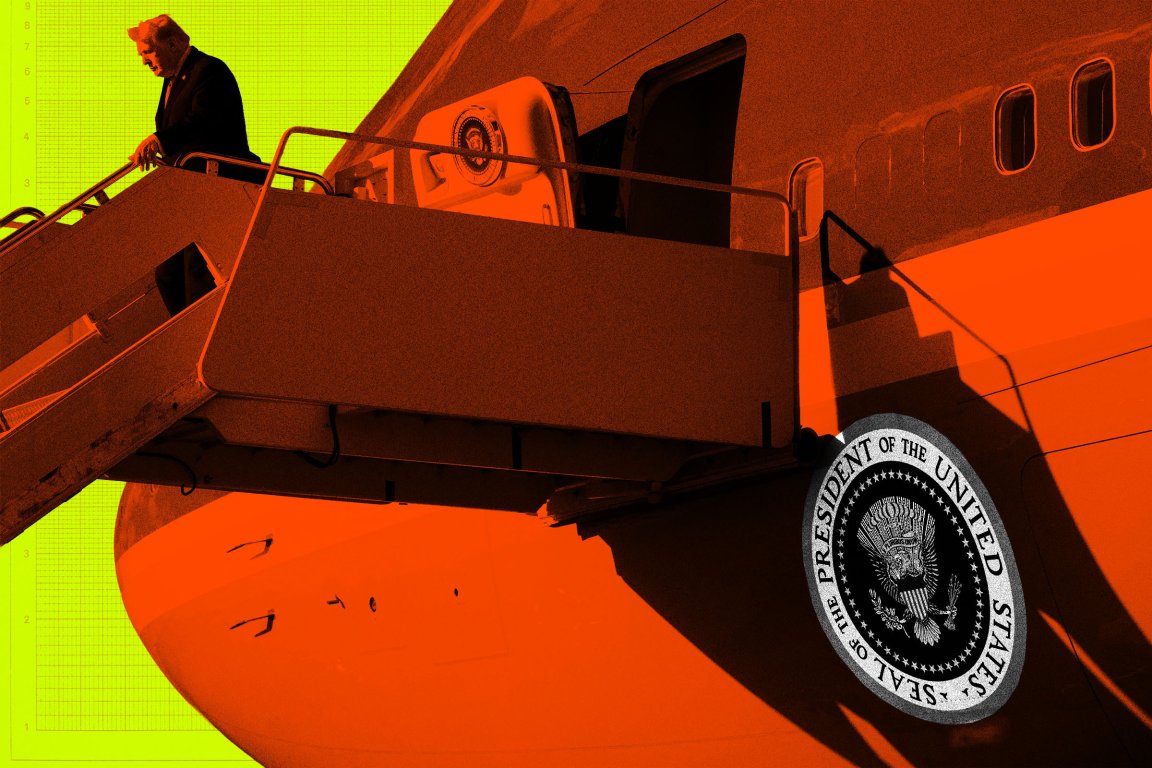
Air Force One Leaked 32,000 Gallons of Jet Fuel Into the Potomac River

The Military Base Home to Air Force One Leaked 32,000 Gallons of Jet Fuel Into the Potomac River Over the Last Few Months
"There's an equation with a lot of blank spaces that have to be filled in."


By Joe Wilkins


Published May 10, 2026 1:30 PM EDT
Add Futurism(opens in a new tab)More information


Illustration by Tag Hartman-Simkins / Futurism. Source: Saul Loeb / AFP via Getty Images


Sign up to see the future, today


Can’t-miss innovations from the bleeding edge of science and tech
Email addressSign Up


With nearly one-fifth of the world’s oil under lock and key thanks to Donald Trump’s ill-fated war on Iran, oil derivatives like jet fuel are at a premium. That makes it all the more devastating that the US Air Force leaked some 32,000 gallons of the stuff into the Potomac river over the course of just four months.

According to bombshell reporting by NOTUS, Maryland’s Joint Base Andrews, the facility that stores and maintains Air Force One, has lost tens of thousands of gallons of valuable jet fuel over two separate leaks. That would be bad enough on its own, but Joint Base Andrews is situated directly on Piscataway Creek, a tributary of the Potomac River.

The timeline established by NOTUS is a little convoluted, but basically this could’ve all been prevented as early as December, when the base’s fuel system failed a critical leak safety test. Across the first two months of the year, base personnel noted the loss of roughly 10,000 gallons of jet fuel, though they believed at the time that the leak was contained to the base itself, and had not impacted the surrounding environment.

On March 23, however, an observer reported what appeared to be oil floating in the Piscataway, forcing the Department of Defense to make an incredibly embarrassing call to the state of Maryland.

Yet according to NOTUS, military officials failed to disclose how much fuel had actually spilled into the state’s waterways during that initial call. It took a further two weeks for the DoD to bring state officials up to speed on the full impact of the leak, prompting outrage from environmental regulators.

“There’s an equation with a lot of blank spaces that have to be filled in,” deputy secretary of the Maryland Department of the Environment Adam Ortiz told NOTUS. “That’s why the rules are what they are. People are supposed to report immediately.”

While it remains to be seen how much of that fuel ended up in the Potomac, the environmental consequences are surely catastrophic. For Maryland officials, the extent of the coverup so far makes it all the more urgent to get to the bottom of things. If the DoD can lie about two separate fuel spills for months, there’s no telling what else has yet to come to light.

“Efforts to properly control, contain, and clean up the release of fuel have been minimal and insufficient,” Maryland’s inspectors wrote in an April 15 report, viewed by NOTUS. “Deadlines are now considered past due.”

More on environmental damages: Trump’s US Forest Service Spraying Deadly Toxins on America’s Woodlands


Joe Wilkins
Correspondent


I’m a tech and labor correspondent for Futurism, where my beat includes the role of emerging technologies in governance, surveillance, and labor.

Private-taxi-for-your-burrito app adds hotel bookings

 Private-taxi-for-your-burrito app adds hotel bookings

Uber taxi sign

Jakub Porzycki/Getty Images

Nothing says cultural immersion like ordering Uber Eats to the accommodation you booked through Uber while you’re Ubering there from the airport. This scenario became reality yesterday: Uber launched a hotel-booking feature for US users.

As part of the rideshare app’s latest effort to become an everything app:

  • A new hotel tab lets you book Expedia accommodations on the Uber app, with Vrbo rentals coming later this year.
  • Uber One subscribers can get discounts on bookings, including 10% back in Uber credits and up to 20% off some hotels.
  • Regular users can apparently also get deals. A Washington Post travel reporter without Uber One said she booked a discounted Hilton room that was slightly cheaper than it would’ve been through Booking.com, Hotels.com, or the Hilton website.

Back scratch: Expedia said it’ll add Uber ride bookings to its app in June. This partnership was a long time coming—Uber’s current CEO previously led Expedia in the 2000s and 2010s, and Uber reportedly considered buying Expedia in 2024.

Other assistant-like offerings announced yesterday include: OpenAI-powered voice booking for rides, a room service-like feature for hotel-door deliveries, and, for Uber Black customers, the option to request that drivers have coffee or food waiting for them.

Shell Puts Canada at Heart of Growth Plans in $13.6 Billion Deal


Shell Puts Canada at Heart of Growth Plans in $13.6 Billion Deal
Shell Puts Canada at Heart of Growth Plans in $13.6 Billion Deal · Bloomberg
Mitchell Ferman and Robert Tuttle
Mon, April 27, 2026 at 9:20 AM PDT 3 min read

(Bloomberg) -- Shell Plc agreed to buy Canadian oil and gas producer ARC Resources Ltd. for $13.6 billion, its biggest deal in more than a decade as it seeks to sustain output in the long term.

It’s the first major acquisition in the three-year tenure of Chief Executive Officer Wael Sawan, who has been pressed recently to bolster the company’s fossil fuel reserves. In the absence of major discoveries, and with Shell saying last year it won’t bid for troubled rival BP Plc, a smaller deal has been the likeliest path to growth.

ARC’s low-cost shale gas and liquid hydrocarbon production complements Shell’s existing operations in Canada, which include a stake in a major liquefied natural gas export facility on the west coast. The country, which under Prime Minister Mark Carney has accelerated approval of energy projects, is now core to Shell’s ambitions, Sawan said.

“This establishes Canada as a heartland for Shell,” Sawan said in a statement announcing the transaction on Monday. The deal “strengthens our resource base for decades to come.”

The deal reinforces the London-based company’s move to refocus on its core oil and gas business in a drive to boost returns to investors. ARC’s assets will raise the compound annual growth rates of Shell’s production between 2025 and 2030 to 4%, up from 1% previously. It will help sustain liquids production toward 2030 and beyond at about 1.4 million barrels a day.


ARC’s shares jumped as much as 24% to the highest in more than 10 years. Shell dropped 1.7% to 3,252.5 pence in London.

LNG Canada

The transaction will help support output from LNG Canada, an important export project that gives access to Asian markets to the country’s natural gas resources. A second phase of expansion is possible at the project, in which Shell has a 40% stake, although Sawan told reporters acquiring ARC doesn’t mean a final investment decision is imminent until at least the end of the year.

ARC’s operations are situated in the same region as Shell’s Groundbirch asset in British Columbia, which supplies LNG Canada, and the Gold Creek project in neighboring Alberta, according to the statement. The acquisition also gives Shell exposure to another export project with ARC’s supply deal into Cedar LNG, a smaller facility under construction nearby.
Story Continues

Domino’s Pizza stock falls on disappointing sales

Domino’s Pizza stock falls on disappointing sales — and CEO thinks more chains will follow
Published Mon, Apr 27 202612:26 PM EDT

Amelia Lucas@ThxamelianWATCH LIVE

Key Points
Domino’s Pizza stock fell after the pizza chain reported disappointing U.S. same-store sales and lowered its full-year forecast.
CEO Russell Weiner said he expects more fast-food chains will report winter weather and weak consumer sentiment hurt their quarterly sales.
Domino’s also faced stiffer competition from rival pizza chains Papa John’s and Pizza Hut.

In this articleDPZ-33.84 (-9.20%)
YUM-4.85 (-3.03%)
Follow your favorite stocksCREATE FREE ACCOUNT


A pedestrian walks by a Domino’s Pizza on Dec. 9, 2025 in San Francisco, California.
Justin Sullivan | Getty Images


Domino’s Pizza stock fell 10% in morning trading on Monday after it reported weaker-than-expected U.S. same-store sales growth.

The chain’s domestic same-store sales rose just 0.9%, lower than the 2.3% bump expected by Wall Street analysts, based on StreetAccount estimates.


“We’re not happy with it,” CEO Russell Weiner told CNBC.

The pizza chain also lowered its full-year U.S. same-store sales forecast to low-single digit growth, down from its prior projection that U.S. same-store sales will increase 3%.

Weiner said he expects more fast-food chains to report similar headwinds from winter weather and weak consumer sentiment, which took a dive in March due to spiking fuel prices caused by the U.S.-Israeli war with Iran.

“One of the bad things about reporting first is you don’t get to hear about anybody else,” Weiner said.

Domino’s kicked off the earnings season for restaurant chains. Starbucks is on deck after the bell on Tuesday, and Chipotle Mexican Grill and Pizza Hut owner Yum Brands are expected to share their results on Wednesday. Rival Papa John’s will report its earnings next Thursday.


During the quarter, Domino’s also faced stiffer competition from rival pizza chains. Papa John’s and Pizza Hut both matched Domino’s $9.99 “Best Deal Ever” with promotions at the same price point. And Little Caesars undercut Domino’s $6.99 Mix & Match deal with a $5.99 version.

“People are seeing what we’re doing, and they’re sick of losing share, and they’re coming at it,” Weiner said, adding that he still expects Papa John’s and Pizza Hut to report same-store sales declines for the quarter despite the new promotions.

Looking ahead, Weiner expressed confidence that Domino’s will prove itself in the long run.

“Domino’s has got a bigger advertising budget than our second two competitors combined,” he said. “And those competitors are both going up for sale, so we know things aren’t good there right now.”

Yum announced in November that it was exploring strategic options for Pizza Hut, which could include a sale. And Papa John’s is reportedly in talks with Qatari-backed Irth Capital to go private. Both chains have also announced plans to close hundreds of restaurants this year, which could further boost Domino’s dominant position in the pizza category.

And if either Pizza Hut or Papa John’s goes private, Weiner said he expects that a new owner would shutter even more locations — a win for Domino’s.

Shares of Domino’s have lost nearly a third of their value over the last year. The company’s market cap has fallen to roughly $11.2 billion.

Prime Minister Mark Carney announces Canada's 1st sovereign wealth fund


Prime Minister Mark Carney announces Canada's 1st sovereign wealth fund

OTTAWA — Prime Minister Mark Carney announced the country's first national sovereign wealth fund on Monday, pitching it as a way for Canadians to invest in nation-building projects.
19778d0b53585bc742f4119e7c1d08a629df1fcbcfdb97311b1a94a48ca502e6
Prime Minister Mark Carney speaks during an announcement on the Canada Strong Fund, Canada's first sovereign wealth fund, in Ottawa on Monday, April 27, 2026. THE CANADIAN PRESS/Justin Tang

OTTAWA —

Prime Minister Mark Carney announced the country's first national sovereign wealth fund on Monday, pitching it as a way for Canadians to invest in nation-building projects.

Carney said the Canada Strong Fund will invest in major Canadian industrial projects in areas such as energy, infrastructure, mining, agriculture and technology.

The prime minister said the federal government will put up funds starting at $25 billion to invest alongside private investors. He said individual Canadians can also put money into the fund and suggested it would be similar to purchasing a government bond, where the initial investment is protected.

Returns from those investments will be put back into the fund to expand its capacity and build out capital projects in Canada.

Speaking to reporters Monday, Carney compared the fund to a "national savings and investment account." He also called it "the people's fund."

Carney cited the Canadian Pacific Railway as an example of a privately funded project supported with public money that ultimately delivered benefits for generations of Canadians.

He said the fund can support construction of new ports, mines and energy corridors that will have similar national benefits.

"We're taking lessons from our history, which is that a lot of wealth has been created in these transformative projects," Carney said.

"It creates an opportunity to invest alongside for Canadians and spread that wealth over time."

Countries such as Norway and many Gulf states already have large sovereign wealth funds. Alberta's Heritage Savings Trust Fund functions in a similar way, by reinvesting proceeds from the province's resource sector.

The Canada Strong Fund will be set up as an independent, arm's-length Crown corporation. The federal government says it will consult over the coming months on the specific design of the investment instrument.

Carney made the announcement Monday morning at the Canada Science and Technology Museum in Ottawa, a day before the Liberal government tables the spring economic update.

The prime minister was asked where the federal government will get the money to cover the initial $25-billion capitalization. He said he didn't want to "front-run" his finance minister's fiscal update.

Finance Minister François-Philippe Champagne, in Montreal to discuss the Canada Strong Fund on Monday, was also asked where the money would be coming from.

Champagne did not answer directly but said the federal government's relatively strong fiscal standing internationally would allow it to borrow at favourable rates.

In Ottawa, Carney suggested there would be "good news" in Tuesday's update on the government's deficits and spending reduction targets.

He was asked by a reporter why the deficit would be lower than projected in the 2025 federal budget back in November.

"Because we're good fiscal managers," he said.

The Liberals' fall budget projected a deficit of $78.3 billion for the last fiscal year, with deficits declining and averaging around $64 billion annually over the five-year horizon.

Carney also pushed back when a reporter suggested the government's revenues would be better because of higher inflation. He noted the annual rate of inflation has been within the Bank of Canada's target range of one to three per cent for the entirety of his time in office.

Many economists predict the federal government's revenue stream will benefit from the recent spike in gas prices tied to the war in Iran. Ottawa has offset some of the higher revenues from the energy shock with affordability measures, such as a pause on the federal fuel excise tax until Labour Day.

Since the fall budget, Statistics Canada has also revised up gross domestic product data from the previous three years, giving the federal government a stronger-than-expected starting point for many of its fiscal guideposts.

This report by The Canadian Press was first published April 27, 2026.

Senate confirmed Kevin Warsh as a Fed governor

 Senate confirmed Kevin Warsh as a Fed governor, with chair vote to come. In a 51–45 vote mostly along party lines, Kevin Warsh, President Trump’s nominee to replace Jerome Powell as Federal Reserve chair, was approved by the Senate to sit on the Fed’s board of governors. That means he’s now cleared to receive a vote to become the Fed chair, which is expected today. If Warsh is named chair (which is all but guaranteed), he’ll assume the post this Friday, taking over for Powell. JPow isn’t going anywhere, however: His term as a governor doesn’t end until 2028, and he’s said he intends to stay put on the board until a federal investigation into his handling of the Fed building’s renovation ends.

Kids are chatting old school

Child using Tin Can phone

Tin Can

The next generation will be expert prank callers: There’s a monthslong waitlist for a screenless, landline-inspired device for kids called Tin Can. The pared-down phone has only been on the market for a year and has already sold hundreds of thousands of units, the startup that sells it told Bloomberg yesterday.

Tech that parents actually like? The wi-fi-enabled phone costs $100, and offers free calls between Tin Cans and to emergency services. Its most popular plan, according to the company, is an extra $10/month that lets users call non-Tin Can phones:

  • The phone was created by Chet Kittleson, a father of three, who says he felt exhausted by the choice between letting his kids get a smartphone or managing all their playdates with friends.
  • His company has since raised an initial $3.5 million, followed by a $12 million seed round in December led by Greylock Partners.

Tin Can says its fastest-growing market segment is bulk orders from schools. This month, the Nativity Parish school in Kansas delivered free Tin Cans to 200+ families of elementary school students.

Big picture: The retro device has attracted parents as lawmakers around the world pitch social media bans for kids. Just last month, Meta and YouTube lost a huge social media addiction trial a day after Meta lost a different child safety case.


It would be foolish to underestimate what Trump is capable of, says author Louise Penny | CBC Radio

It would be foolish to underestimate what Trump is capable of, says author Louise Penny | CBC Radio

It would be foolish to underestimate what Trump is capable of, says author Louise Penny

New book explores plot to make Canada 51st state, written before Trump's re-election

Text to Speech Icon
Listen to this article
Estimated 5 minutes
A woman and man talk on a stage
Bestselling author Louise Penny told Matt Galloway it was 'a bit of a shock' to hear U.S. President Donald Trump talk about Canada becoming the 51st state, especially as it was the plot of her already-written new book (Andrea Stanford/CBC)
LISTEN | Two countries, one community:

Bestselling author Louise Penny says it would be foolish to dismiss the 51st state rhetoric that U.S. President Donald Trump has repeatedly leveled at Canada. 

“I think that there is not a country that's been invaded, a peoples who have been targeted … who hasn't looked back and thought, what did I miss?” Penny told The Current’s Matt Galloway in a special show with a live audience.

“Where was the moment when it could have been stopped? And I think we're living through that moment right now,” she said.

Penny was speaking on stage at the Haskell Free Library and Opera House, a unique venue that is split by the U.S.-Canada border. Part of the building is in Stanstead, Que.; part is in Derby Line, Vt.

The venue has become embroiled in the simmering tensions between the two countries over the past year, as Trump started a trade war and threatened to use "economic force" to annex Canada and make it the 51st state. Earlier this year, the U.S. government limited access on the U.S. side, forcing the library to renovate and create access on the Canadian side. Penny contributed to that renovation fund, which raised more than $140,000.

A black border line runs along the floor of the Haskell Free Library, which straddles the boundary between Canada and the United States. (AP Photo/Toby Talbot)

Her latest novel, The Black Wolf, explores a sinister plot to make Canada the 51st state — though she’s keen to point out she wrote the novel before Trump was re-elected. She spoke to Galloway about her surprise as the plot became real-world politics, here is part of their conversation. 

You gave $50,000 for a new door for the Canadian side that some of our Canadian guests may have come through. 

I do just want to say that the reason I could afford to do that is because of [my readers’] support. Because financially, I've been so fortunate over the course of a 20-year career. And so it just seemed natural, absolutely natural to say thank you and give some — not all of it — give some of it back. 

You also said, creating the new door, these are your words, it's like giving the finger to the current administration. You close one door, we'll open another.

Well, and how symbolic are doors? Doors. They closed a door. And how elegant is the solution on the Canadian side, totally supported by the American part of the organization here, to just say, 'Well, that's all right. We'll just open our own.' And that's what happened. 

You're good friends with Hillary Rodham Clinton, you wrote a book with her.

Yes.

WATCH | Hillary Rodham Clinton and Louise Penny on writing together:

Hillary Rodham Clinton and Louise Penny on their political thriller, State of Terror

October 15, 2021|
Duration2:43
Good friends Hillary Rodham Clinton and Louise Penny talk about their first novel together, State of Terror, which follows newly appointed U.S. secretary of state Ellen Adams and her race to stop a series of international terrorist attacks.

Have you had any conversations with her about what's going on right now?

A few. 

Would you care to share the tenor and the tone of those conversations? 

I do want to say she loves the Eastern Townships. She loves coming up. She was here this past summer and she said that it's the first time since the inauguration that she's felt safe. I've never heard her say that before. I think she's afraid for the first time physically, but she is certainly afraid for the American democracy and the American republic.

You started this book before Trump was re-elected, right?

I started this because it's two halves of a whole, starting with the Grey Wolf and then the Black Wolf is the second half of it. So in fact, it was designed three years ago. 

WATCH | How a Quebec town pushed back against new rules for library:

Quebec town pushes back as U.S. tightens access to iconic border-straddling library

March 21, 2025|
Duration2:29
Once a symbol of partnership between two friendly nations, the Haskell Free Library and Opera House in Stanstead, Que., has become a point of tension lately, with American authorities now deciding the way it functioned for decades posed too much of a border security risk.

And so how do you, at that point, start thinking about 51st state, long before those words have come out of the current president's mouth? You said to me that you worried that you'd gone too far. Now you worry whether you didn't go far enough. 

It was a bit of a shock to hear Trump talk about the 51st state.

If you read the book you'll see that it just seems, I hope, like a natural progression. 

And then when it actually happened in the real world, obviously as a Canadian I was appalled. And unsure how seriously to take it. I think we're still trying to parse that. The other part was obviously thinking more personally, if this is in my book, are people going to think that I've simply ripped it from the headlines and ripped it off and taken advantage of what is a very shattering experience?

How seriously should we take it? 

That is a really interesting question. I think it would be foolish to underestimate what he's capable of. I think that there is not a country that's been invaded, a peoples who have been targeted or an individual who's been rounded up, who hasn't looked back and thought, what did I miss? Where was the moment when it could have been stopped? And I think we're living through that moment right now. 

And it behooves all of us, certainly behooves me because I'm 67. I am 20 years into a career that has so overshot any of my expectations. If I don't stand up, and I am in a position where I can, then shame on me. I think it's time that we stood up, those of us who can.

RG Richardson Communications News

I am a business economist with interests in international trade worldwide through politics, money, banking and VOIP Communications. The author of RG Richardson City Guides has over 300 guides, including restaurants and finance.