RG Richardson Business & Economics

RG Richardson Business & Economics
Interactive financial ebooks

China builds a rival satellite constellation as SpaceX goes public

 China builds a rival satellite constellation as SpaceX goes public


A Chinese state-backed satellite company is signing the partners and governments Starlink has pushed aside, days before SpaceX’s record listing.

Rest of World/iStock
By INDRANIL GHOSH
+
11 JUNE 2026
TRANSLATE


Chinese upstart Spacesail is trying to steal SpaceX’s thunder.

State-backed Spacesail launched two satellites on a reusable rocket on June 1, just days before SpaceX’s $1.8 trillion listing on June 12, the largest public offering to date. Much of SpaceX’s valuation rests on Starlink, the satellite internet service, which has over 10 million customers across 100 countries.


Spacesail appears to be deliberately targeting countries where Starlink has faced issues.”Blaine Curcio, founder of Orbital Gateway Consulting

Starlink’s 7,000 satellites dominate internet service in virtually every market where they are present. User growth slowed in the first quarter of this year as sign-ups tapered in established markets, and rapid expansion left a trail of disgruntled partners and regulators.

Meanwhile, Spacesail launched three batches of satellites in five days, reaching 200 in orbit on June 5. The company has moved into markets where Starlink’s complacency had created openings.

“Spacesail appears to be deliberately targeting countries where Starlink has faced political or regulatory issues, or other market issues,” Blaine Curcio, founder of Orbital Gateway Consulting, a Hong Kong-based firm tracking the Chinese space industry, told Rest of World.

Tech reporting from beyond Silicon ValleySee the full picture of how technology is shaping the world. Twice a week, straight to your inbox.

Email


SpaceX and Spacesail had not responded to Rest of World’s queries by the time of publication.
Going head-to-head

For governments that previously had no alternative to Starlink, Spacesail’s arrival changed the negotiating dynamic. A second provider, backed by Chinese state financing and willing to work on their terms, gave them the leverage they did not have before.

Starlink had signed a reseller agreement with state-linked satellite operator Measat in Malaysia years before Spacesail arrived. Measat then undercut its own partner by bringing in competing resellers, Curcio said. Spacesail signed its first international partnership with Measat early last year.

Starlink’s dominance led to similar friction in Africa, where users in several cities had no alternative provider as service quality declined. Spacesail last year registered trademarks in South Africa.

Governments across Africa have welcomed the prospect of a new entrant, Temidayo Oniosun, CEO of Space in Africa, a Lagos-based firm tracking Africa’s satellite industry, told Rest of World.

“After gaining market share, Starlink has done several price increases because the competition isn’t there,” Oniosun said. “People in those cities may be looking for alternatives.”

In 2024, SpaceX CEO Elon Musk refused to comply with a Brazilian court’s orders to moderate content on his social media platform X — leading to a five-week ban, and an opening for Spacesail. After Chinese President Xi Jinping visited Brazil for the G20 summit in November that year, a Spacesail deal with Brazil’s state telecom followed, and the telecom regulator granted Spacesail an operating licence in February, Curcio said.

In Kazakhstan, Starlink’s project to connect 2,000 schools stalled in 2024 after the company refused to meet the government’s data security requirements, he said. Spacesail registered a subsidiary in the country in January 2025.

Airbus agreed in December to include Spacesail’s network on its in-flight Wi-Fi platform, a deal that took Spacesail’s reach beyond individual country markets. Thailand’s state telecom signed a partnership in April, and Spacesail is reportedly negotiating with roughly 30 other countries.

Spacesail raised over $1 billion in 2024, and is seeking fresh capital to expand its constellation to 15,000 satellites by 2030. The June 1 launch used a new Chinese reusable rocket, similar to the technology that had allowed SpaceX to build Starlink affordably.

With 200 satellites now in orbit, Spacesail said it has enough capacity to support its first commercial application: tracking maritime vessels at sea. The company aims to begin broader commercial services by the end of 2026.
The U.S. is watching

Spacesail’s expansion into Starlink’s growth markets carries direct implications for U.S. companies that rely on satellite connectivity abroad, and for investors in the SpaceX IPO.

The growing dependence of countries on Chinese space infrastructure should alarm U.S. policymakers, said Ellis Scherer, a space policy analyst at the Information Technology and Innovation Foundation, a Washington-based think tank that tracks Chinese space capabilities.


China still lacks a mission-ready, fully reusable rocket like SpaceX’s Falcon 9.” Ellis Scherer, space policy analyst, Information Technology and Innovation Foundation

“China still lacks a mission-ready, fully reusable rocket like SpaceX’s Falcon 9,” Scherer told Rest of World. “Until such a rocket is successfully developed by a Chinese company, Spacesail’s launch cadence will continue to lag significantly behind SpaceX’s, limiting Spacesail’s competitive edge.”

Even where Spacesail gains a foothold, replacing Starlink will take time, Oniosun said. Users who have invested in Starlink may be reluctant to pay again for Spacesail hardware — although in cities where Starlink’s quality has dropped because of overloaded capacity, users may be more open to a new provider, he said.

The IPO also reflects SpaceX’s expansion into AI computing. After merging with Musk’s company xAI in February, SpaceX now operates data centers in Memphis, Tennessee. In its regulatory filing, the company has disclosed a deal under which Google will pay approximately $920 million a month for computing capacity at those facilities through June 2029.

Spacesail’s playbook of state backing, non-Western markets, and government-level deals resembles that of BYD, the Chinese electric car maker that grew with billions in subsidies and overtook Tesla in global sales, Curcio said.

The parallel holds in strategy, but satellite internet has a grim track record: Iridium, Spacesail’s best-known predecessor, had failed before it found a viable business, Curcio said. Spacesail also has a rival at home in China — state-owned company SatNet — with which it competes for rockets and government support, he said.

“Other than Starlink, effectively no other satellite constellations have been very successful, at least before declaring bankruptcy first,” Curcio said.

Indranil Ghosh
+ is the Middle East and Africa Editor at Rest of World, based in Abu Dhabi.

How much money does the US federal government collect?


How much money does the US federal government collect? 
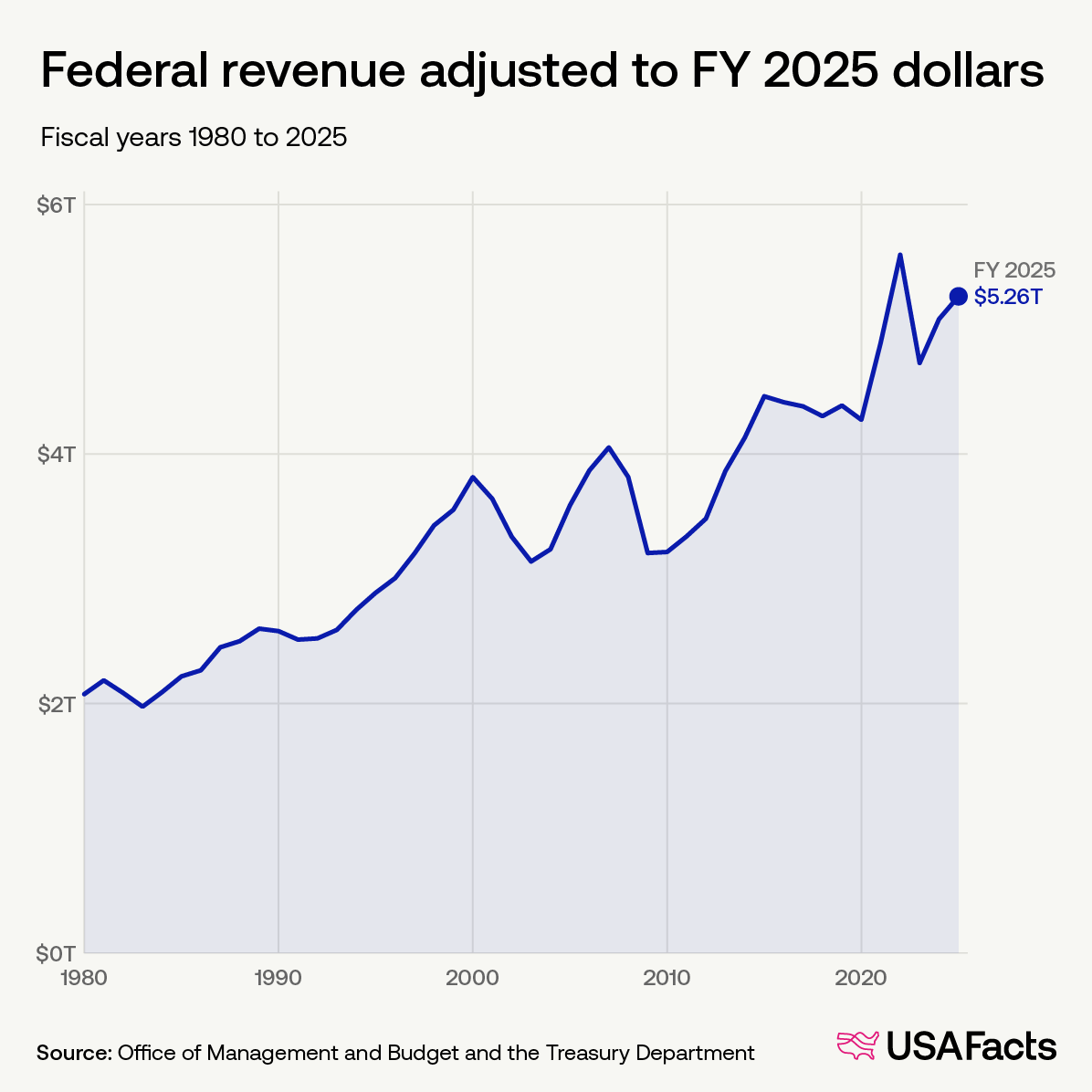
Federal revenue has increased 2.5 times from FY 1980 to 2025 (adjusted for inflation), while the nation’s population increased about 1.5 times. That means the government is collecting more revenue per person, on average, than it used to. Let’s look at what the government collects and how that’s changed.  
  • Government revenue is the total amount of money received from individual and corporate taxes, as well as other sources. In fiscal year 2025, the federal government collected $5.26 trillion, or about $15,400 per person in the US. Of course, the amount collected per person varies based on their income and other factors.  
     
  • Revenues were up 3.6% from the $5.08 trillion collected in FY 2024 after adjusting for inflation. Higher revenue from individual income taxes drove this growth from the year prior, and could have been due to a variety of factors, including income growth or the number of taxpayers. 
  • For comparison, federal revenue was up 19.9% from the $4.39 trillion collected in FY 2019, just before the COVID-19 pandemic.  
     
  • The government shares preliminary revenue data on what it’s collected so far this fiscal year, which began on October 1, 2025. The early data shows it has brought in $1.25 trillion in individual income taxes and $870.5 billion in payroll taxes in the first six months of FY 2026. 
     
  • The government’s fiscal year 2026 budget deficit was about $954 billion as of this past April. 
     
  • For a deeper dive into how the government collects revenue, watch this video featuring USAFacts Founder Steve Ballmer.  

How many jobs did the US add last month?


How many jobs did the US add last month?

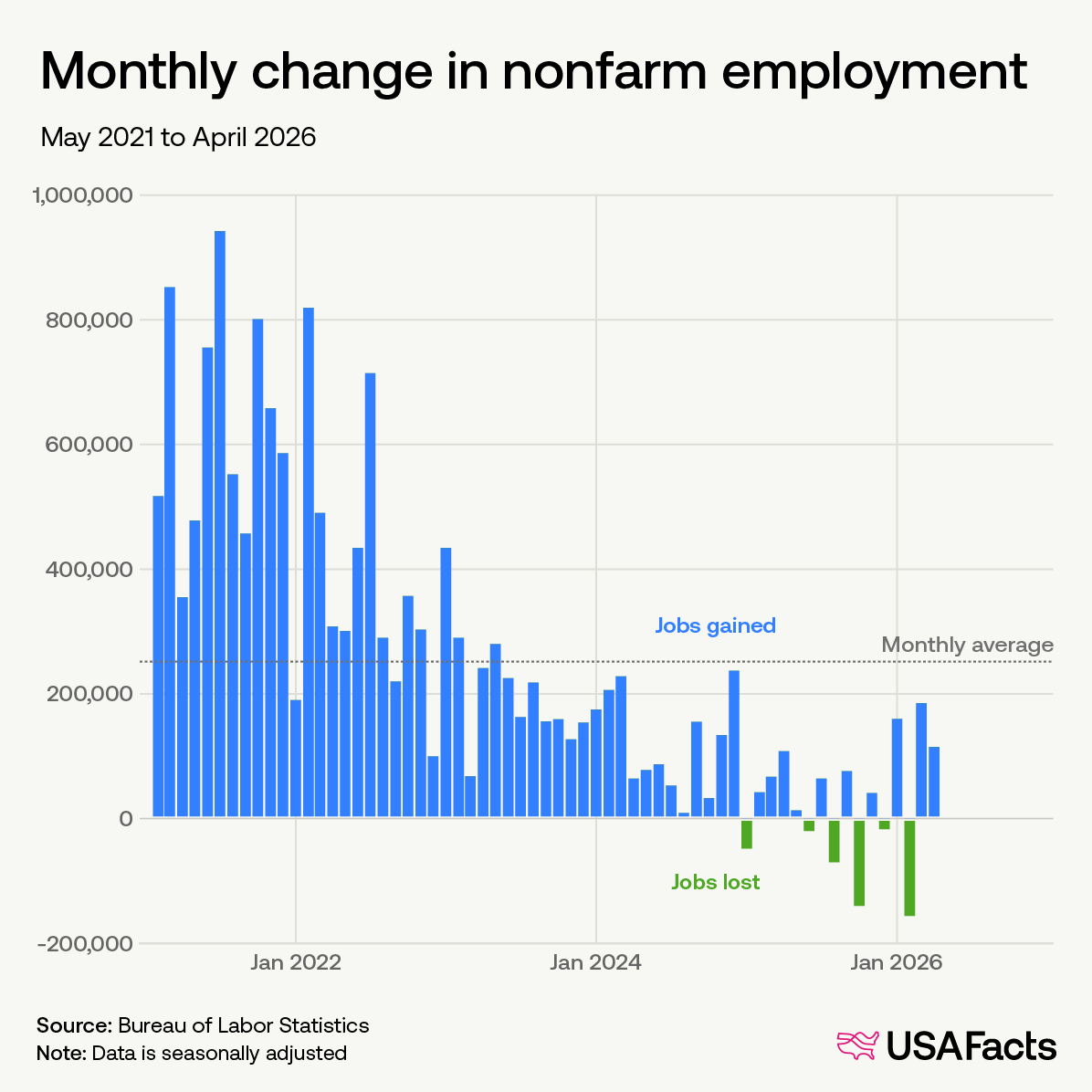
The Bureau of Labor Statistics’ (BLS) monthly jobs report shows that the nation added about 115,000 jobs in April, below the monthly average of 239,800 over the last five years. We’ve just updated our site with the newest state and metro job data, so let’s take a look at the numbers.

  • The BLS organizes and reports employment data by grouping industries into very broad categories called supersectors. Last month, the supersectors with the highest job growth were professional and business services (7,000 jobs added), and mining and logging (3,000 jobs). Meanwhile, the information supersector lost 13,000 jobs, financial activities lost 11,000, and the government lost 8,000.

  • The US has gained an average of 20,900 jobs monthly from April 2025 to this past April. For comparison, the nation added an average of 79,600 jobs per month from April 2024 to April 2025.
     

  • The US gained jobs in 54 out of 60 months spanning May 2021 to April 2026. The most gains were in July 2021 (942,000 jobs added), while job growth was weakest in February 2026 (a loss of 156,000 jobs).

  • Forty-two states and Washington, DC, gained jobs last month. Florida gained the most, 40,500, while New York lost the most: 10,600. Don’t forget to check the data on your state and metro area on our site!
     

  • The BLS often revises these figures months after they’re first reported. Here’s why.

Meta So Desperate for Compute That It’s Building “Data Centers” That Are Just Tents Filled With AI Chips

 Meta So Desperate for Compute That It’s Building “Data Centers” That Are Just Tents Filled With AI Chips


Futurism · a day ago
by Joe Wilkins · Artificial Intelligence


It’s a desperate time for tech companies trying to assert dominance in the AI boom. Back in April, we found out that nearly half of the data centers that were supposed to open this year had been cancelled or significantly delayed — putting a bottleneck on an industry which will live or die by its ability to access AI chips.

The situation has grown so frantic that Mark Zuckerberg’s Meta has even started building tent-pole data centers with portable gas turbines, Michael Thomas, founder of data center tracking company Cleanview, explained in a recent social media post.

As part of its “Prometheus” project, a gigawatt-scale data center campus in an exurb of Columbus, Ohio, Meta has erected six massive weatherproof tents to speed up the deployment of its precious AI chips. Per Thomas, each so-called “rapid deployment structure” is 125,000 square feet in size, all powered by a 200-megawatt generator facility nearby.

Lined up in a row on a dirt construction site, the buildings look more like industrial chicken farms than traditional data centers.


Meta is building dozens of massive tents at campuses across the US, sticking billions of dollars of chips inside, and powering them with off-grid turbines.

The AI race has officially entered its Mad Max phase.

Over the last month, I reviewed hundreds of documents and satellite… pic.twitter.com/U8yDZUlEO0— Michael Thomas (@curious_founder) June 4, 2026

The use of these canvas structures has helped Meta cut down the time it takes to deploy a barrage of AI chips from years to months, Thomas explains. The first five actual buildings at the Prometheus campus took around two to three years to build, for example, whereas the six canvas structures are already up despite beginning construction between April and June of this year.

To be fair, Meta hasn’t exactly tried to hide any of this. In a blog post from 2025, Meta wrote that “we needed to find innovative ways to scale” their AI compute.

“We accomplished this by building this cluster across several of our traditional data center buildings as well as several weatherproof tents, and adjacent co-location facilities,” the explainer reads.

The revelation has garnered some understandable comparisons to the early days of Tesla, when Elon Musk used canvas structures to house his assembly lines in a similarly desperate scramble to get a product to market.

As more and more communities across the United States successfully shut down years-long data center construction projects, it’s not unthinkable that more data center developers turn to tents to plug their chips into the grid as soon as possible. These six chicken huts, in other words, could just be the beginning.

More on data centers: Data Centers Have Become Shockingly Unpopular, Poll Finds

The post Meta So Desperate for Compute That It’s Building “Data Centers” That Are Just Tents Filled With AI Chips appeared first on Futurism.

Meta workers are straight up not having a good time

 Meta workers are straight up not having a good time

Meta HQ sign

Josh Edelson/Getty Images

The vibes at Meta headquarters right now aren’t just bad, they are downright rancid. Starting this morning, waves of emails will start arriving in nearly 8,000 employees’ personal inboxes, informing them that their jobs are terminated. Workers had been dreading the mass culling since it was first leaked by The Information in March, but Meta didn’t address the layoffs with staff until last month.

What’s the damage? The layoffs affect about 10% of the ~78,000 workforce. Earlier this week, the company said in a memo that it would also move 7,000 employees to AI-related initiatives and close 6,000 open roles.

Morale at the Facebook parent company is reportedly at an all-time low:

  • Things have gotten so bad that some employees are begging for the virtual pink slip and the 16 weeks minimum of severance, Wired reported.
  • An employee who worked at the company for over a decade told the San Francisco Standard, “I tend to cry in the shower.”
  • Another worker said large empty boxes began arriving at a few of the Menlo Park offices before today’s layoffs, and no one could give employees an answer as to why.

Layoffs are just the tip of the AIceberg

CEO Mark Zuckerberg said in 2022 that the layoffs were a correction to Covid-era overhiring, but the recent rounds are meant to free up funds for AI spending. The tech giant has pledged to spend as much as $145 billion this year on artificial intelligence.

In April, Meta rolled out a new program internally that tracks employees’ every move on their computers. The company said it would use the data to train AI models on “how people actually complete everyday tasks using computers.”

Big picture: Many Meta workers have pushed back, with some launching a petition urging execs to end the tracking program, and UK workers attempting to unionize. Meta, meanwhile, is reporting record profits.

Nvidia’s new PC chips represent CEO Huang’s bid to win at every layer of AI stack

Nvidia’s new PC chips represent CEO Huang’s bid to win at every layer of AI stack
Published Tue, Jun 2 20268:00 AM EDT

Katie Tarasov@KatieTarasov

Kif Leswing@kifleswingWATCH LIVE

All MAGA?

Key Points
Nvidia’s announced entry into the PC chip market sent shares of AMD, Intel and Qualcomm lower on Monday as Wall Street recognized the threat.
Jensen Huang, Nvidia’s CEO, signaled his intent to “reinvent the PC.”
Analysts see Nvidia moving beyond the data center and to the so-called edge, as smaller devices become capable of running AI workloads without tapping the cloud.

In this articleNVDA-0.23 (-0.10%)

Jensen Huang, chief executive officer of Nvidia Corp., presents the RTX Spark Superchip at the Nvidia GTC conference on the sidelines of Computex 2026 in Taipei, Taiwan, on Monday, June 1, 2026.
Lam Yik Fei | Bloomberg | Getty Images


As important as Nvidia has become to the tech industry, its entire run-up in recent years has been tied to the data center. Now the chipmaker is going after the PC market, and Wall Street is recognizing the threat it poses.

During a keynote address at Taiwan’s Computex conference on Monday, Nvidia CEO Jensen Huang said his company, along with Microsoft, is going to “reinvent the PC.” Nvidia’s plan to build system-on-chips, or SoCs, for PCs sent shares of Advanced Micro Devices, Intel and Qualcomm downward.


It’s the latest sign of Nvidia moving beyond the data center for artificial intelligence and to the so-called edge, where smaller devices like phones or computers run advanced AI models on their installed chips without tapping the cloud.

“Nvidia getting into the space is Jensen recognizing that he wants to own every bit of the AI stack in some shape,” said IDC analyst Tom Mainelli.

While makers of PC central processing units, or CPUs, and mobile phone chips sank on Monday, Nvidia’s stock popped more than 6%. With a market cap of about $5.4 trillion, Nvidia is worth more than any company on the planet, and is almost $1 trillion above its closest U.S. peer.

Nvidia is officially entering the PC market with a chip called RTX Spark, which is a joint effort with Taiwan’s MediaTek. The RTX Spark, which Huang also referred to as the N1X, debuts later this year on a fresh line of Windows PCs from Microsoft, Dell, HP, ASUS, Lenovo and MSI.

“This reinvention of the computer is as big of a deal as the reinvention of the phone into what we now know as the smartphone,” Huang said, pointing to the fact agentic AI will run across all new computers.


watch now
VIDEO02:46
D.A. Davidson’s Gil Luria says Nvidia’s push into PC chips is ‘a very big deal’


Nvidia has a major balance sheet advantage and has all the momentum in the world. But that doesn’t mean it’s going to be easy to crack a market that has historically been controlled by the duopoly of Intel and AMD. Additionally, Qualcomm has introduced new SoCs for Windows laptops in the past two years, and Apple, which has about 9% of the PC market, started making its own processors in 2020.

Nvidia’s rise has been fueled by selling systems based around the data center graphics processing unit, or GPU, which is better suited for running cutting-edge AI models with unlimited power, cooling and space. As chips become powerful enough to perform AI at the edge, Nvidia is racing to get there.

“All AI computing, regardless where it is, that’s the prize,” said chip analyst Patrick Moorhead. “Jensen is not going to be happy if they just get data center or data center and auto. They want everything on the edge.”
Second chance for AI PCs


Financially, the PC is just a blip for Nvidia, at least in the near term.

Creative Strategies analyst Ben Bajarin estimated on Monday that Nvidia’s networking business alone — which reported about $15 billion in sales in the most recent quarter — will be at least 20 times the size of Nvidia’s PC business. Total data center revenue in the latest quarter topped $75 billion.

Intel’s client computing group, mostly comprised of PC chip sales, reported $32.2 billion in revenue for all of 2025.

“PC for Nvidia is highly underpenetrated, so this is the start of an attempt to gain share for an edge story,” Bajarin said.

Jay Goldberg, an analyst at Seaport Research Partners, wrote in a note he doesn’t expect material numbers from Nvidia’s PC chips “any time soon.” He has a sell rating on the stock.

It’s also far from the high-growth market that Nvidia’s been leading since generative AI took off in late 2022. Market researcher IDC estimates that 296 million PC chips were shipped in 2025, increasing for the first time in three years, but still well below the pandemic-era peak of 361 million in 2021. Nvidia could sell 10 million PC chips over the next two years, Moorhead said.

The “AI PC,” a concept introduced by Microsoft and its PC partners in 2024, hasn’t sparked much of a revival, due to a lack of new software and Microsoft’s challenges with its Copilot technology.

But some analysts say Nvidia’s prowess in AI could bring a different level of enthusiasm and credibility.

“Nvidia’s not the first to do it,” Mainelli said. “But because they bring the GPU chops and because so much of AI in the cloud is built on Nvidia, the fact they’re pushing this out to the device is pretty interesting.”

Nvidia’s RTX Spark chips will pair the company’s cutting-edge Blackwell GPU with a MediaTek CPU on the same SoC. It will also have a feature called unified memory, which allows the CPU and GPU to access the same memory on a single SoC, eliminating a major AI bottleneck and allowing the chip to run bigger and more capable AI models.

In revealing the chip, Huang connected the technology to one of the hottest trends in Silicon Valley: AI agents. Every developer is seemingly obsessed with their ability to run agents like OpenClaw or Hermes Agent in the background to become much more productive.

Huang suggested that those kinds of agents might run perfectly well locally, where they’ll be cheaper than in the cloud.

“Look how beautiful it is — this agent could run 24/7, meter free,” Huang said, holding up a small Nvidia-based computer from MSI. “No meter anxiety.”

Nvidia CEO Jensen Huang introduces the RTX Spark during his keynote speech at Computex 2026 in Taipei on June 1, 2026. Nvidia unveiled a powerful laptop chip for Windows machines on June 1, staking its claim in the market for next-generation consumer PCs integrated with artificial intelligence.
Photo by I-Hwa Cheng / AFP via Getty Images
Another chip in the x86 wall


Nvidia’s announcement is also the latest sign of the power of Arm.

For decades, CPUs have been built on the x86 instruction sets pioneered by Intel in the 1970s and AMD a couple decades later.

Arm’s alternative power-efficient architecture went mainstream when Apple adopted it for the first iPhone in 2007. Then Amazon popularized Arm-based chips for data centers when it announced its in-house Graviton processor in 2018. Nvidia tried to buy Arm for $40 billion in 2020 in a preview of its SoC ambitions. The deal was spiked by regulators.

Cloud rivals Google and Microsoft followed Amazon with their own custom Arm CPUs for data centers. Now the entire CPU market is having a resurgence as mass AI adoption shifts from call-and-answer chatbots to task-oriented agentic apps. The overall market for CPUs is exploding into what Huang says will be a $200 billion industry.

Within the CPU renaissance, a flurry of companies have been switching from x86 to Arm.

Apple ended a 15-year reliance on Intel x86 chips in 2023, and now uses its own Arm-based processors for its computers. The latest MacBooks released in March come with a higher price tag and Apple’s latest M5 CPU.

Arm unveiled its first in-house CPU in March, with Meta, OpenAI, Cloudflare and SAP as early customers. AMD is also reportedly working toward an Arm-based PC chip.

Nvidia’s RTX Spark chips are likely to show up first in pricey computers, with budget options coming down the road. Nvidia-powered computers with AI features from companies like Adobe and Microsoft could be the first laptops in years to give Apple’s MacBooks significant competition in the premium category.

“This is the closest thing to take on the MacBook Pro for the Windows ecosystem,” Moorhead said.

Americans’ electric bills are skyrocketing as utilities rake in record profits

Americans’ electric bills are skyrocketing as utilities rake in record profits


MS NOW · a day ago
by Ali Velshi · Velshi

This is an adapted excerpt from the May 31 episode of “Velshi.”

Just search “utility companies” under news, and you’ll find a familiar story playing out across the country: report after report of skyrocketing electric bills and mounting public anger with service providers. Out-of-control utility bills have become another aspect of the country’s affordability crisis, driven by an industry operating with too little accountability.

Retail electricity prices rose 7% in 2025 alone, part of a nearly 40% rise since 2021, which makes it the fastest period of electricity price growth on record. The average household’s monthly electric bill has climbed from roughly $121 in 2021 to $156 today, marking a nearly 30% increase that outpaces inflation.


In the words of the American Economic Liberties Project’s Matt Stoller: “Where’s all the f&$*#ing money going?”

Meanwhile, utility companies continue to ask regulators to let them charge even more money. In just the first three months of this year, utility companies sought approval for $9.4 billion in rate increases. That follows a record-setting 2025, when they requested $31 billion, more than double what they sought the year before.

According to the consumer advocacy group Powerlines, “Today, nearly 80 million Americans are struggling to pay their utility bills, forgoing basic expenses like food, education, and health care to keep their lights on.”

In the words of the American Economic Liberties Project’s Matt Stoller: “Where’s all the f&$*#ing money going?”

For their part, the utility companies will point to extreme weather, aging infrastructure, the transition to cleaner energy and now the enormous power demands of data centers. And while that is real, it doesn’t add up — and it hasn’t for years. We have been paying more for years.

The government has increased spending on the U.S. transmission system fivefold over the past two decades. But if all that money were actually fixing the grid, why do we keep hearing the grid is unreliable? Why do we keep hearing we need even more?

The answer lies in the utility business model, the part most people never hear about. Most people assume utilities work like ordinary businesses. They don’t. A regulated utility does not primarily make money by selling you electricity at a markup. Nearly every dollar it spends on operating costs is ultimately recovered from customers through rates approved by government regulators.

The real profits come from something else: capital investment.

When a utility builds a power plant, transmission line, substation or other major piece of infrastructure, regulators allow it to recover those costs from customers over decades.

On top of that, the utility earns a guaranteed return on the money it invested. And that return is not trivial; for most investor-owned utilities, it falls somewhere between 9.5% and 11%. Compare that with what you earn in a high-yield savings account today, which is around 4% if you’re lucky.

According to the Energy and Policy Institute, a watchdog group that calls for greater accountability in the utility sector, investor-owned utilities pocketed $244 billion in profit off customers from 2021 through 2024.

Here’s the breakdown of those costs, according to the group’s executive director: “If a customer has a $200 electric bill, something on the order of $30 isn’t paying for electric poles, or wires, or power plants. It’s paying a wealth transfer to Wall Street and the company’s executives.”

Now, it should be noted, this is an analysis that industry groups dispute. But consider the incentives that kind of business model creates. If you’re guaranteed a premium on every dollar you spend, what’s your next move? It is likely not fixing the grid or upgrading aging facilities; it’s spending more dollars.

Build more projects, deploy more capital. Whether those projects are the most efficient solution or even strictly necessary becomes a secondary concern.
Play
The Data Center Boom Has a Power Problem May 10, 2026 / 10:15

That helps explain one of the strangest features of America’s electricity system. As Stoller puts it, utilities are “truly paid to fritter away money, to gold-plate and waste.” And, if that’s not bad enough, in some states these same utilities can spend your money on political activities.

According to the Energy and Policy Institute, in states where laws prohibit utilities from charging customers for political spending, consumers are saving hundreds of millions of dollars a year.

Meanwhile, you, the average customer, are sitting around believing that paying more will lead to a better grid. That is the implicit bargain behind every rate increase. Customers are told that higher bills today will lead to a more reliable system tomorrow. Yet the opposite complaint seems to be growing louder every year.

The federal organizations responsible for monitoring the nation’s electric system have repeatedly warned that large portions of the country face increasing blackout risks as power demand grows and existing infrastructure ages.

Ultimately, the problem is that the system rewards spending itself: A utility that finds a cheaper solution earns less, and a utility that spends billions building — not fixing — infrastructure earns more.

As Stoller puts it, “They are willing to waste $1,000 to send an extra $60 to shareholders.”

Many experts argue that one of the most effective ways to lower costs and improve reliability would be to build more high-voltage transmission lines connecting different regions of the country.

Think of the electric grid as a national marketplace. Some regions have abundant, inexpensive electricity. The Great Plains, for example, have some of the world’s best wind resources. The Southwest has enormous solar potential. Other regions, particularly dense population centers in the Northeast and parts of the Midwest, often face higher electricity costs and tighter supply constraints.

The obvious solution is to move more power between these regions. Done correctly, these projects can lower costs, improve reliability and make the entire system more resilient.

But that requires coordination. Large interstate transmission projects involve multiple states and multiple regulators, more oversight. And crucially, they don’t fit as neatly into the business model that rewards individual utilities for expanding their own assets.

As a result, utilities favor smaller local projects that are easier to approve, easier to build and guaranteed to generate shareholder returns.

Other countries have moved far more aggressively to build long-distance infrastructure capable of moving power across vast regions. Look at China, which has built more than 8,200 miles of high-voltage transmission lines in recent years. The U.S. has built a mere 375.

At this point, you may be wondering: Where are the regulators? After all, utilities don’t operate in a free market. Customers can’t simply switch providers when rates rise.

The entire justification for granting utilities monopoly status is that government regulators are supposed to act on behalf of the public. In theory, that’s the safeguard. In the real world, that has become part of the problem.

Consider a recent example in Pennsylvania. When the Pennsylvania utility PECO — a subsidiary of Exelon, the largest utility in the country — recently asked for a return of nearly 11%, far above the national average, it took the governor publicly shaming them to get it withdrawn.


Customers are told that higher bills today will lead to a more reliable system tomorrow. Yet the opposite complaint seems to be growing louder every year.

Democratic Gov. Josh Shapiro called PECO’s proposed rate hike “pure greed.” In response, PECO said in a statement that the company “shares Governor Shapiro’s concerns about affordability and remains focused on keeping customer bills as low as possible while continuing to invest in safe and reliable service.”

The rising costs led Shapiro to launch a new watchdog to scrutinize utility profits.

But critics argue that many of the state commissions that are supposed to oversee these utilities have been effectively captured. The revolving door between regulators and utility companies means that today’s watchdog can become tomorrow’s utility executive, and vice versa.

At the same time, utility companies are often permitted to contribute money to the campaigns of officials involved in overseeing them. The result is regulatory capture, with the system increasingly serving the interests of the companies rather than the ratepayers it was designed to protect.

That’s why the industry’s response to virtually every challenge sounds so familiar. Need to strengthen the grid against storms? More spending. Need to accommodate renewable energy? More spending. Need to support artificial intelligence data centers? More spending. Need to improve reliability? More spending. And systems rarely reform themselves when the people involved are benefiting from the status quo.

Most Americans don’t understand the mechanics of rate bases, transmission planning or regulatory capture. They don’t need to. What they understand is that their bills keep rising. They understand that every year seems to bring a new explanation for why prices have to go up again.

For much of the 20th century, utilities were largely run by engineers. Their mission was straightforward: keep the lights on. Today, the system is run by financial engineers focused on returns on their investments.

Allison Detzel contributed.

The post Americans’ electric bills are skyrocketing as utilities rake in record profits appeared first on MS NOW.

Dell high-end lightweight laptops costing $3,000


Dell’s Massive XPS Price Hikes Spell the Doom of Cheap PCs
Welcome to the age of high-end lightweight laptops costing $3,000 or more.
BY KYLE BARRPUBLISHED MAY 18, 2026, 2:15 PM ET

READING TIME 2 MINUTES

The Dell XPS 16 now costs nearly 20% more than it did a few weeks ago. © Raymond Wong; Gizmodo composite
READ LATER COMMENTS (10)


No laptop can escape the plague of spiking RAM prices. In what feels like a watershed moment for notebooks everywhere, Dell’s longtime high-end XPS laptops now cost close to or more than $3,000 if you want the latest and greatest specs and screen.

The company’s revised XPS 14 and XPS 16 models were supposed to help get the company’s notebook brands back on track. Now, these already expensive laptops cost nearly 25% more. When we first reviewed the XPS 14, it cost $2,200 for the high-end model that comes with an Intel Core Ultra X7 358H chip, 32GB of RAM, and the OLED touch display. Now, as of May 18, the laptop costs $2,900 at Best Buy. An XPS 16 came with a $2,350 price tag when Gizmodo reviewed it this month. Now, it’s $2,950.

These laptops cost even more on Dell’s own webstore (these laptops also come with limited game and creative software bundles when ordering direct from Dell). Those prices are not even the highest-end version of the laptops. There are additional configurations with a higher-end Intel Core X9 388H that cost $3,000 at 14 inches and $3,050 at 16 inches. Overall, Dell’s new pricing scheme for its longtime XPS laptop lineup feels more like our PC-loving brains are being pile-driven into hard concrete.


There is one non-OLED version of the XPS 16 with the same chip that currently costs $2,480 on Dell’s online storefront. In an email, a Dell spokesperson confirmed that these were indeed the new prices of its 2026 XPS models, adding, “It has been a dynamic time in our industry for component costs along with other factors.”

Just two years ago, you could expect to grab a decently powerful gaming laptop with an OLED screen and a discrete GPU for under $3,000. In 2026, Dell’s beloved Alienware brand now hopes to sell an Alienware 15 “budget” laptop starting at $1,300 for the lowest-end configuration and costing $2,300 with a higher-end GPU and 32GB of RAM.

Essentially, the pricing scheme consumers had come to expect for all PCs is getting thrown out the window. Fellow PC maker Lenovo recently spiked the price of its Legion Go 2 gaming handheld to $2,000. More device makers are actively considering scaling back the capabilities of their gadgets in order to keep prices steady, a process best described as “shrinkflation.”

Gizmodo was pretty positive about Dell’s redesigned XPS models. They featured bright, beautiful OLED displays, strong performance with Intel’s latest Core Ultra Series 3 chips, and a high-quality chassis. Sure, their seamless keyboards grew increasingly annoying to type on, but they at least captured their own unique look in a world full of dull, gray boxes.

Are either of these laptops worth close to $3,000? It may not matter anymore. Soon, more and more PCs may hike costs to compensate for the ballooning prices of RAM and other memory components.

SpaceX Is Truly Out of This World


UNFTR Weekly Roundup

Follow us on Bluesky, and check out Max’s contributor videos on the MeidasTouch Network!

Was this newsletter forwarded to you? Sign up here!


Max Notes

NOTE: This is a special edition of the newsletter. Because of the magnitude of this IPO, I decided to dedicate the entire newsletter this week to SpaceX. I dug through the prospectus and some of the most recent news surrounding the IPO to finally piece together the extent of the massive fraud that’s about to take place on the Nasdaq this Friday. We’ll return with the regular newsletter next week, but for now I thought it best to pour my energy into what very well be the IPO that changes the stock market forever. 


SpaceX Is Truly Out of This World

In 2021, Donald Trump merged his cash-hemorrhaging Truth Social into a blank-check SPAC and took it public. The product was functionally Twitter for people banned from Twitter. The financial press laughed, retail investors got vaporized and it dropped from the headlines as quickly as it appeared.


That was embarrassing. This SpaceX IPO is something altogether different. Donald Trump is a pickpocket on the grift scale compared to Elon Musk who’s about to make the pyramids disappear.


On June 12, 2026, SpaceX lists on the Nasdaq at $135 a share, valuing the company at $1.77 trillion—the largest IPO in American history, raising roughly $74.4 billion, more than all U.S. IPOs combined over the past two years. Pretty impressive for a company that loses money across every operating segment. But don’t worry, the upside is huge. All you need is a little faith.


Every IPO prospectus has a Total Addressable Market (TAM) slide. SpaceX’s S-1 has claimed, in a federal securities filing, that their TAM is $28.5 trillion—described as “the largest actionable total addressable market in human history.” For the sake of comparison, the current U.S. nominal GDP is approximately $29 to $30 trillion.


Ergo, SpaceX is claiming its addressable market is the entire American economy.


Here’s how they get there:

  • $370 billion in Space
  • $1.6 trillion in Connectivity
  • $26.5 trillion in AI

The actual business: rockets, Starlink, and X (formerly Twitter.) These divisions made up the $18.67 billion in 2025 revenue and threw off a net operating loss of nearly $5 billion. One of the stars of the portfolio is Starlink, which boasts 10.3 million subscribers. It’s a modest base for a company priced at the GDP of a continent, but okay. The company does send up a ton of rockets into space and is paid by various contracts, most notably the United States government.


Morningstar put the fair value of the IPO at $780 billion—56% below the IPO price. More than half the valuation is a narrative premium on a money-losing business. Investment advisor George Pearkes told More Perfect Union: “The combination of sheer size and this extreme multiple is completely unprecedented.” Robin Wigglesworth, editor at the Financial Times added, “Based on the numbers that we know, that is absolutely batshit.”


They just don’t understand. It’s almost like they didn’t read the prospectus. I mean, it’s all right there in black and white. The mission statement clearly says, “To build the systems and technologies necessary to make life multiplanetary, to understand the true nature of the universe, and to extend the light of consciousness to the stars.”


And here I thought they were raising money to power Grok queries like, “Grok, put tits on my second grade teacher’s Facebook profile picture.”


I suppose the biggest valuation in history on an unprofitable company seems reasonable if you’re Elon Musk with designs on colonizing space. Here on Earth, however, we have things like gravity, reality and actual numbers to contend with. So let’s go through the actual revenue picture for each business segment.


There’s a case to be made for “space” as this is where SpaceX currently makes its money. They launch satellites and other “payloads” into orbit for their own network of connected satellites and on behalf of other organizations ranging from governments and militaries to multinational firms. And while it doesn’t directly state how much revenue it derives from the U.S. government, it mentions it in the “risk factors” (which we’ll go through in a bit) saying, “In 2025, approximately one-fifth of our revenue was attributable to agencies within the U.S. federal government.” So the guy who tried to gut the federal government for wasteful spending made 20% of his bag from the very same government. Cool.


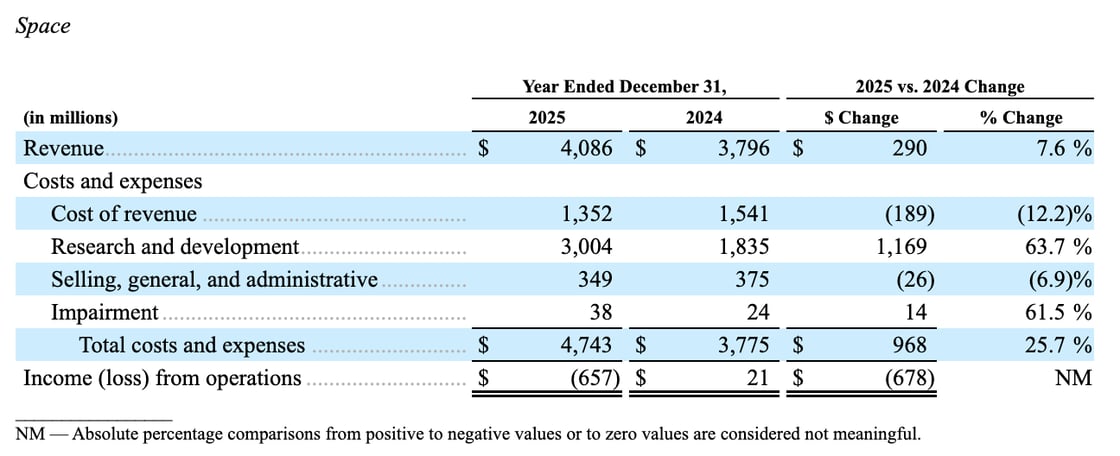
Anyway, here’s how “Space” revenue breaks down as of the IPO.

So far “space” has been a losing proposition for the company named SpaceX. In 2025 it lost $657 million on $4 billion in revenue and overall revenue was only up 7.6% from 2024, also a losing year. Not exactly the type of returns that warrant a 50x valuation. I guess the “Connectivity” picture is a heckuva lot better.

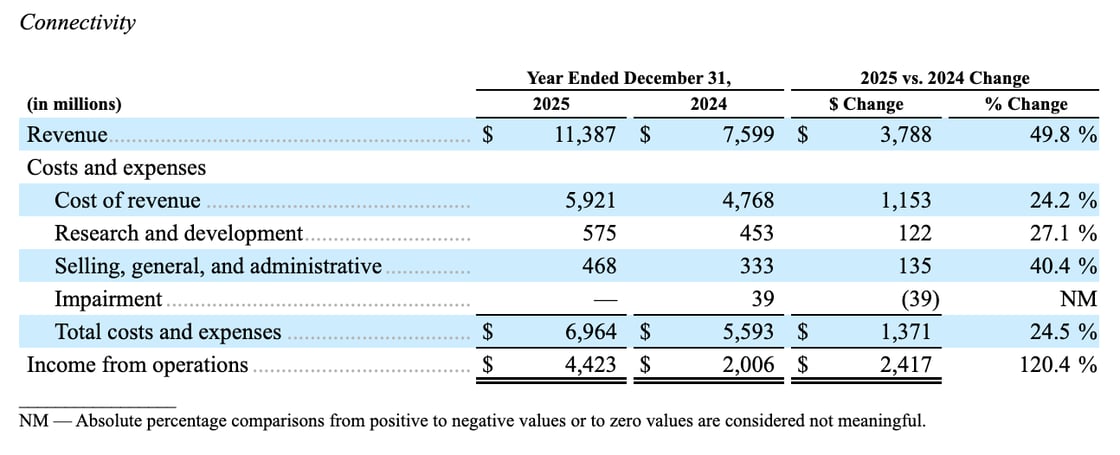
There it is. Show me the money baby. $11 billion in revenue with $4.4 billion to the bottom line. Of course the average revenue for a Nasdaq 100 listed company is somewhere between $30–$35 billion, so they have a bit of catching up to do, but at least this offsets the losses in “space.” Still, nothing here seems to warrant the extravagant valuation and potential raise of $75 billion at listing. That must mean that AI is the hidden treasure in all of this. Let’s have a look under Grok’s hood.

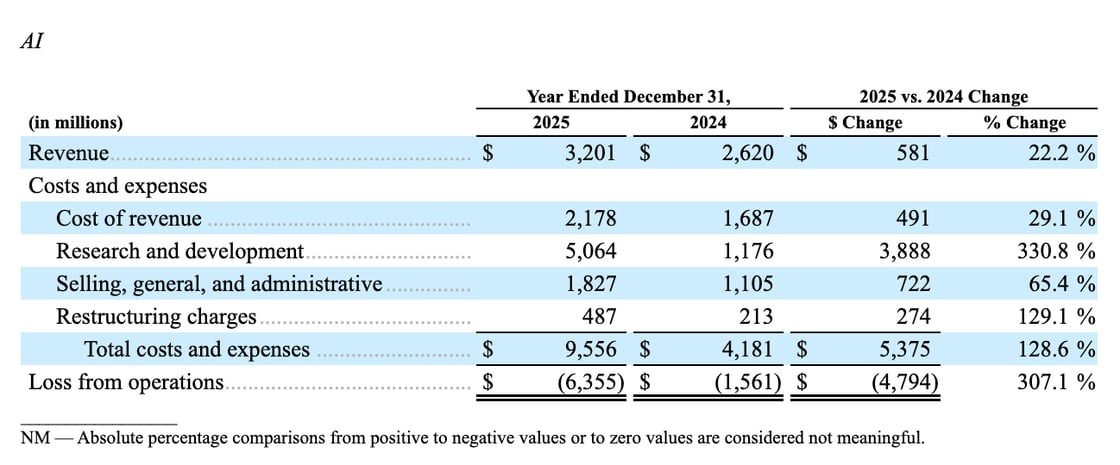
Holy shit. They spent $9.5 billion to make $3.2 billion. Good lord. Oh, Grok you money grubbing little bitch. I guess we’ll have to dig a bit deeper on this since the AI piece is 93% of their projected TAM.


Of the total, the prospectus lists $22.7 trillion as “enterprise applications.” Awesome. What’s that you might ask? No one knows. That figure is not revenue; it’s a projection from a company with no enterprise AI revenue, for a market that does not yet exist. And whatever revenue that exists from its core model is light years behind its competitors, as Grok ranks fourth globally in AI chatbot web traffic—behind ChatGPT, Gemini, and Claude.


Where most of the other AI leaders fake sincerity when it comes to saving humanity, Elon has no such hangups. This is the man who built up his side of PayPal without money laundering guardrails to boost revenue before Peter Thiel engineered his ouster. The same dude who built a tunnel under Las Vegas without permits or safety precautions. Who’s building autonomous cars so dangerous that entire countries have banned them. The same guy who gave 20-something coders from X access to our Social Security data when DOGE tried to rip apart the government.


Common Sense Media rated Grok “among the worst” AI chatbots for safety, documenting nearly 6,700 sexually suggestive image requests per hour. The FTC has an active child safety inquiry. The Irish Data Protection Commission opened a GDPR investigation into how xAI handles children’s data. The S-1 describes Grok as “a truth-seeking AI model built on our founder Elon Musk’s mission to enable humanity to understand the universe.” A chatbot under investigation in two jurisdictions for what it did to kids is, per the prospectus, a tool for understanding the cosmos.


The xAI merger—folding Grok and X into SpaceX—was also done without a fairness opinion. Morningstar called it “a material threat of value destruction.” The Colossus data center, xAI’s flagship compute cluster, is selling spare capacity to Anthropic—whose Claude is beating Grok in global rankings. SpaceX’s best AI hardware is underutilized by its own product.


That makes the S-1’s enterprise AI strategy of “deepen[ing] enterprise and government adoption” less of a strategy and more of a to-do list entry.


The most entertaining part of the prospectus is the pages upon pages of “risk factors.” To be fair, these are always fun to read in any IPO, because the lawyers have to think of everything to make sure investors are fully informed of the business risks. But these take the cake. Here’s a smattering of “risk factors” investors have to look past to believe that Elon Musk is about to build a company with a market cap the size of the U.S. economy.


“We have experienced, and will likely continue to experience, launch delays and failures that could have a material adverse effect on our business, financial condition, results of operations, and future prospects.”


“Current FAA regulations do not permit return-to-launch-site reentries for Starship”


“Certain of our AI products, including Grok, offer features or modes designed to generate more candid, direct, or less reserved or irreverent outputs, such as ‘Spicy’ Imagine Mode and ‘Unhinged’ Voice Mode…they present heightened risks, including reputational harm, the generation of potentially explicit content and misinformation or deceptive outputs, potential nonconsensual or exploitative imagery.”


“AI technologies…may be flawed, insufficient, of poor quality, rely upon incorrect, inaccurate, harmful or illegal data, reflect unwanted forms of bias, hallucinate, misrepresent, mislead or contain other errors or inadequacies…certain of our AI products, such as Grok, have been alleged to be susceptible to ‘data poisoning’ in the past.”


“Others, including in-orbit manufacturing, passenger transport to the Moon, an established human presence or gateway hub on the Moon, passenger and cargo transport to Mars, energy production on the Moon or Mars, manufacturing capabilities on the Moon or Mars, and asteroid mining do not exist today.”


“We do not maintain key-person life insurance on Mr. Musk…he does not devote his full time and attention to our businesses.”


“Upon completion of this offering, Mr. Musk will beneficially own a majority of the outstanding shares of our Class B common stock and a majority of the voting power…and therefore will be able to elect all the members of our board. Mr. Musk…can only be removed from our board or these positions by the vote of Class B holders.”


“Our substantial level of indebtedness could materially adversely affect our financial condition.”


“The continued proliferation of satellite constellations in Low-Earth Orbit, as well as the risk of collisions with space debris or other spacecraft, could limit or impair our launch flexibility and satellite deployment, which could adversely affect our business, financial condition, results of operations, and future prospects.”


“Many of our initiatives, including those to develop orbital AI compute at scale, manufacture AI chips at scale, establish a lunar economy, develop human augmentation systems, and transport humans and cargo to the Moon and Mars, involve significant technical complexity, unproven technologies, or technologies that do not exist or may require significant advancement, and such initiatives may not achieve commercial viability.”


“Several of our anticipated market opportunities, including certain AI, orbital, lunar, and interplanetary transportation and industrial activities, are still emerging and evolving or do not currently exist, and such markets may not develop as we expect, or at all.”


And, finally. The most honest statement of all.


“We have a history of net losses and may not achieve profitability in the future.”


Elon’s Tulip Moment

The real kick in the teeth is how many retail investors are likely to get burned in the coming months. A company being rushed to market on hype and bold promises is nothing new. Nearly everything else about this particular IPO is either very new, or so old that it’s new again. And all of it is shady.


Here’s the breakdown of the go-to-market con.


SpaceX is issuing, or “floating” less than 5% of company shares to create artificial scarcity that forces a day-one spike. It’s also allocating 30% of the offering to retail—three times normal. It could be a sign that institutional investors won’t pony up for the list price, though it’s not for lack of trying as we’ll see in a moment. Either way, that’s a lot of average Joe’s skin in the game.


The most audacious aspect of the IPO is that Musk managed to push a rule change through Nasdaq. It’s called a “fast entry rule” that lets SpaceX enter the Nasdaq 100 in just 15 trading days instead of up to a year. No SEC approval required. Musk reportedly conditioned his listing on the fast track; Nasdaq had direct financial incentive. The reason this is so significant is that index funds that own the Nasdaq 100 represent passive investments from all over the world. Nearly a third of all American stock is tied to passive indexes such as these. For example, your 401(k) may wind up owning SPCX whether you ever heard of Grok.


That covers the entry point, but the off ramp is even more insidious. There’s something called a “lockup” period that restricts the earliest investors with premium share holdings from dumping their stocks after the initial surge. Not so in this instance. The SpaceX lockup is engineered for fast exits. Insiders—Andreessen Horowitz, a Saudi prince, a Palantir co-founder, Jack Dorsey—all got SpaceX stock through the Twitter→xAI→SpaceX merger chain, and they can begin selling 20% of their stakes at the first quarterly earnings call, weeks after listing. With estimates of nearly $50 billion in retail and passive flows heading into this deal it means a significant portion of that can be liquified in a matter of weeks by the early investors.


We have measures to prevent this kind of behavior, mind you. But the largely self-policed Wall Street under Donald Trump is reverting back to the good old days. Joseph Kennedy would be proud. And there are a lot of dirty hands in this deal.


Nearly two dozen banks are splitting $500 million-plus in fees—the largest IPO fee haul ever. Goldman Sachs and Morgan Stanley are both primary underwriters and had analyst teams circulate projections of a $3.4 trillion market cap by 2040—not published, leaked informally to investors during the live deal.

On CNBC, Andrew Ross Sorkin raised the obvious:


“This is something that banks frankly did not do—were not allowed to, to some degree—post that global settlement that Elliot Spitzer made back, I want to say, what was it? 2001, 2002? If you can publish internally and then leak them—and you happen to be the underwriter—what does that say?”


What it says is nobody learned anything from the dot-com crash.


Even Jamie Dimon—the man who holds himself out there as the voice of reason, the steady banking hand who plays it all above board—held a private event for 350 wealthy investors—Robert Kraft taking time away from the strip club in the front row, Kenneth Langone beside him—and called it the “democratization of finance.” Those clients face no trading restrictions post-IPO. Fidelity retail customers who sell once within 15 days get locked out of future IPOs. Dimon said ”democratization” to describe a deal where billionaires get a free exit and regular people get a holding penalty.


Sometimes Rockets Explode

Listen. SpaceX the company is remarkable. Most of their shit doesn’t blow up. They go to space and leave things there that communicate back to Earth. I can be flip about it and say whoopdeedo we landed on the moon almost six decades ago, but the fact of the matter is these guys are doing stuff that most of us can’t wrap our heads around. So if it was just that, just a company doing cool shit in space and a normal valuation that didn’t upend every rule and protection of the market and put tens of billions of dollars at risk to line the pockets of a guy who freely gives a Nazi salute, then maybe it wouldn’t be such a hit.


But “remarkable” and “worth $1.77 trillion” are not the same sentence. It’s a literal fuck you that insults the intelligence of anyone who can read a prospectus. The $990 billion gap between Morningstar’s fair value and the IPO price is a bet on orbital data centers that can’t yet exist legally, on a $22.7 trillion market invented to make the math work, on a chatbot under federal investigation.


It’s not actually a company. It’s just an IPO. A shell. Perhaps a balloon. Truth Social with rockets.


One final number for your consideration to erase any remaining doubt about who this ultimately benefits. The CEO’s salary: $54,080 a year. His performance bonus—one billion Class B shares—vests when a city of a million people exists on Mars. A second tranche of 302 million shares vests when non-Earth data centers reach 100 terawatts of compute—roughly four times current global electricity consumption, in space. That’s designed to make you think that there are real incentives for Elon in the future. But the rigging of the Nasdaq listing, quick exit from the lockup and control of the Class B shares are all the frontloaded incentives he needs to add hundreds of billions of dollars to his net worth.


That’s really what this is about. And, he’s going to use your retirement accounts to get there whether you want it, authorize it, or even know about it.

RG Richardson Communications News

I am a business economist with interests in international trade worldwide through politics, money and banking. Interactive Internet VoIP and secure eMail Communications. The author of RG Richardson City Guides has over 300 guides, including restaurants and finance.