Sign up today

Sign up today
Softphone APP for Android &IOS

David Foster and friends to play free Inner Harbour


David Foster and friends to play free Inner Harbour concert in August

Jay Leno, Josh Groban and Katharine McPhee will be among the guests as the David Foster Foundation, which supports the families of children with organ transplants, celebrates its 40th anniversary.
web1_davidfosterfoundation_gala_4
David Foster will be accompanied by the Victoria Symphony at the Inner Harbour event, with surprise guests expected to appear. DAVID FOSTER FOUNDATION

Victoria’s David Foster will ­celebrate four decades of fundraising with a red-carpet event and concert at the Inner Harbour this summer.

The Grammy Award-winning producer will be joined by Jay Leno, Josh Groban, Katharine McPhee and others for 40th anniversary celebrations for the David Foster Foundation, which includes an Aug. 7 black-tie gala fundraiser and private party at the Victoria Conference Centre and an Aug. 8 free concert at the Inner Harbour.

“This one is going to be our last major fundraiser of the foundation,” Mike Ravenhill, chief executive officer of the David Foster Foundation, told the Times Colonist on Tuesday. “David and I were talking, and we thought, why not come back to Victoria, where we started, and do our last major fundraiser?”

The foundation, which provides financial support for families with children in need of life-saving organ transplants, has assisted upwards of 1,600 families with a variety of non-medical expenses, including travel, accommodation and mortgage assistance.

The foundation will move away from large-scale events in the future, Ravenhill said, in order to transition from a fundraising foundation into an operational foundation that administers its multimillion-dollar endowment.

The David Foster Foundation got its start in Victoria in 1986, and later included celebrity softball games as part of its initiatives.

John Travolta, Michael J. Fox, Rob Lowe and Olivia Newton-John were among the ball-playing guests during the 1980s, before the foundation switched to concerts as its primary means of raising funds.

The foundation’s 25th anniversary events in 2012 also featured a Victoria gala and concert, with Wayne Gretzky, Muhammad Ali and Michael BublĂ© helping to raise $4.6 million for the ­charity.Additional performers on tap for the 40th anniversary events this summer include the Tenors, former American Idol contestant Pia Toscano, America’s Got Talent finalist Daniel Emmet, and Jersey Boys actor-singer Erich Bergen.

“We wanted to come back and say thank you to Victoria,” Ravenhill said. More guests will be announced in the coming months, he added. “We are going to have lots of entertainers, lots of energy and lots of surprises.”

The celebration at the Victoria Conference Centre will be followed by an exclusive VIP after-party at the Fairmont Empress, featuring live performances by The London Essentials and the Rhapsody Orchestra.

Foster will perform on a floating barge accompanied by the Victoria Symphony at the Inner Harbour event, with surprise guests expected to appear.

“We are going to take the bar and raise it,” Ravenhill said.

For more details, visit ­davidfosterfoundation.com.

Mainstream media

 I have almost come to the end with mainstream media! Their constant spin of "Trump says," twenty-four seven is over for me. There is a worldwide economic war, which demands clarity and reliable sources. In Canada, the opposition right-wing politicians have their own interests, not exactly Canadian. Mark Carney provides leadership for Canada and the rest of the free world as his trade deals top 1 trillion dollars. Democracy is at stake here, and a repeat of WWII is not the order of the day! We can unite again!

NBA expansion to Seattle


Illustration of the NBA logo being stretched out and expanded.

Nick Iluzada

Get ready to learn coffee and desert air, buddies. The NBA’s board of governors voted unanimously yesterday to begin the vetting process to add a 31st and 32nd franchise in Las Vegas and Seattle, respectively, for the 2028-29 season.

The franchise entrance fee is just a bit more than what you paid to join your rec league: ESPN reports that the new clubs will be expected to pay the NBA $7 billion to $10 billion for the privilege of having Charles Barkley make fun of them. However, the announcement comes at an inopportune time:

  • While next year’s salary cap will reportedly rise by $10 million, that’s still about $1 million lower than projections, due to a decline in local media revenue.
  • The tanking problem, aka intentionally losing or fielding bad teams in order to get better draft picks, is worse than usual (see: whatever the Brooklyn Nets did here). And expansion teams historically struggle at first, which could make tanking an even bigger issue.

But that depends on the NBA’s expansion draft rules. The NHL tweaked its system to benefit its recent Vegas and Seattle expansion teams: Vegas went to the Stanley Cup Final in year one, while Seattle made the playoffs in year two.

Zoom out: Despite rampant tanking and a $1 million shortfall, the NBA will survive. Overall viewership was up through last month’s All-Star break.

Anthropic’s latest AI model strikes fear into banks

 Anthropic’s latest AI model strikes fear into banks

Close crop of a 100 dollar bill disintegrating into pixels, with Ben Franklin's face obscured a bit so his eyes are visible.

Morning Brew Design

An impromptu meeting of bank CEOs and federal officials was held in the nation’s capital this week because of the destructive capabilities of Anthropic’s latest AI model, Claude Mythos, which can detect cybersecurity flaws in operating systems and web browsers with exponentially greater efficiency than human hackers.

Fed Chair Jerome Powell and Treasury Secretary Scott Bessent gathered the heads of Bank of America, Citigroup, Goldman Sachs, Morgan Stanley, and Wells Fargo on Tuesday after the limited rollout of Mythos, per Bloomberg. The emergency meeting is a sign that the Trump administration thinks that, while Mythos is intended to protect companies from hackers, it could be used to attack the foundation of the US financial system by targeting the world’s biggest banks.

What’s so scary?

Anthropic distributed Mythos to only ~40 organizations, which include major banks, according to Bloomberg, because the company said it’s too powerful for a full release to the public. CNBC reported that the company also briefed government officials on its capabilities before the release. So, how dangerous is it?

  • Officials believe Mythos can debilitate Fortune 100 companies, infiltrate national defense systems, and take down huge chunks of the internet, according to Axios.
  • A security expert told Business Insider that a team of humans can discover about 100 critical flaws with no immediate fixes per year (not including what happens on bad first dates), but Mythos can find “thousands.”

Offense vs. defense: Mythos is equally capable of identifying and exploiting weaknesses in a system. Experts told BI that this gives hackers an advantage in the short term. But as widespread adoption occurs, the edge shifts back to those defending themselves.

Safety net: Regulators require banks to hold capital in reserve to cover unexpected losses from events such as data breaches and cyberattacks. But banks have complained that they require too much, and a proposal from the Fed last month, if approved, would ease some of those requirements.

Zoom out: The concerns over Mythos come as Anthropic is fighting the Trump administration over being designated a supply chain risk by the Pentagon after limiting the use of its AI tech in war.

Rogue waves!

Rogue waves! What can they teach us about managing risk at sea
Yachting Monthly
March 31, 2026
0shares


Managing known risks is one thing, but how do you prepare for unexpected events? Mark Chisnell examines the problem of rogue waves
TAGS:


If there is a single point on the planet that figures in the imagination of every sailor, it’s Cape Horn. It lies at the southern end of the South American continent, squeezing the wind and waves of the South Pacific Ocean into a 500-mile gap between South America and Antarctica, right where the deep water of the South East Pacific Basin shallows on to the continental shelf. It’s a lethal combination.

Conor O’Brien’s Saoirse was the first yacht to successfully go around in 1923, and it was 35 years before a second, the Tzu Hang, would clear customs in Melbourne with Montevideo in mind.
Calm before the monster wave

The Tzu Hang was 46ft long, originally built in Hong Kong from teak with copper fastenings, and in 1951 it was bought by Beryl and Miles Smeeton. Miles was a career army officer, and it was after his service in the Second World War that they took up sailing. In 1955, they sold the farm in British Columbia that had been their home since the war and took off in the boat. Like so many people before and since, they set off across the Pacific. Unlike many others, on reaching Australia they turned back east, sailed down into the high latitudes and attempted to round Cape Horn.
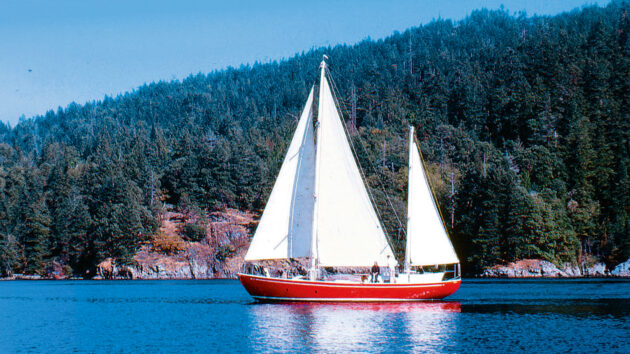

The Smeetons were the second sailors ever to round Cape Horn in a sailing yacht, the Tzu Hang. Photo: Tor Johnson Clio Smeeton

It all started well enough; in his book, Once is Enough, Miles Smeeton describes an idyllic life onboard. They had the fire stoked up like a country pub on a winter weekend, with the cat curled up in front
of it.

Beryl Smeeton had taken to knitting jumpers, and her breakfasts of porridge, bacon and eggs, toast and home-made marmalade all washed down with tea would have shamed some British bed-and-breakfast hotels. The bunks were real beds, oatmeal cakes were baked, pudding was cooked at any excuse and the England versus Ireland rugby match was on the radio: blissful really – until 12 February 1959.
Deteriorating conditions

Things had been deteriorating for a while.

The Smeetons and their crew mate, John Guzzwell, had reduced the sail of Tzu Hang and were trailing over 100m of 8cm-thick cable out of the back of the boat. The hope was to slow her down and help keep her in line with the breaking waves.

The swell was bigger than they had ever seen before – Miles Smeeton described a seascape that was as different from a normal rough ocean as a winter landscape is to a summer one. There was white foam and spume everywhere, showered like confetti by the breaking crests of the huge waves; it lay over the ocean like Christmas snow.
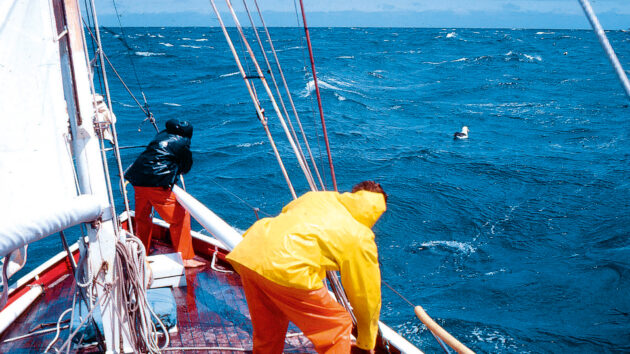

Clio Smeeton took this colour photo of her parents handling a whisker pole on deck at sea aboard Tzu Hang. Photo: Clio Smeeton

And for the first time since the Tasman Sea, the albatrosses had disappeared – this, it turned out, was ominous.

Miles was in his bunk reading when it happened, his wife on deck at the helm. He described what she saw: ‘Close behind her a great wall of water was towering above her, so wide that she couldn’t see its flanks, so high and so steep that she knew Tzu Hang could not ride over it. It didn’t seem to be breaking as the other waves had broken, but water was cascading down its front, like a waterfall.’

After that, Beryl Smeeton remembered thinking that she could do nothing else with the helm, then the sensation of falling and no more, until she found herself floating alone, in the Southern Ocean, with just the broken tether of her lifeline for company.

It was only when she was lifted by the following wave that she saw the boat just 30m away, both masts gone and very low in the water – which was unsurprising, when you consider that the deckhouse had been ripped off.


Miles and Beryl Smeeton aboard Tzu Hang with their daughter Clio, and pets
Inside the maelstrom

It’s arguable whether Miles Smeeton and John Guzzwell were any better off down below. They were hurled around the cabin along with everything that wasn’t tied down and quite a bit of what had been. Then the vanishing deckhouse had allowed the cold black sea to pour in, as Tzu Hang was rolled over and under that huge wave.

They both surfaced into waist-deep water, awash with cushions, mattresses and books – and one seriously unhappy cat. Miles made it on deck in time to see his wife swim to the remains of the mast, from where she pulled herself to the boat on the still-attached rigging and was hauled back on board by the men.

Article continues below…


What to do when your yacht hits a rock under autopilot


Emma and Karl are cruising the Outer Hebrides aboard their Sweden 390, Vision. They put the boat on autopilot after…


Sailing in waves: top tips to keep you safe at speed


Sailing in waves can make for a jarring, juddering experience and long, uncomfortable passages and at worst, a dangerous, boat-rolling…

Their home was full of water, and there was a 2m hole where the deckhouse had been. Both masts were gone, as were the rudder, dinghies and the cabin skylights. The rigging, guardrails and stanchions were a mass of twisted metal. There was no life raft, and no hope of rescue.

The men just stood and stared in despair, but Beryl went for the buckets. She galvanised them all, and their energy was rewarded with luck. John Guzzwell quickly found nails, a hammer and wood in the chaos below. He worked like a demon to make Tzu Hang watertight again, before another wave took her down for good. Meanwhile, Miles and Beryl bailed, and bailed, and bailed. It took 12 hours to get the water down to the level of the floorboards – had there been any floorboards left.

Then, exhausted, they managed to heat some soup, and slept.
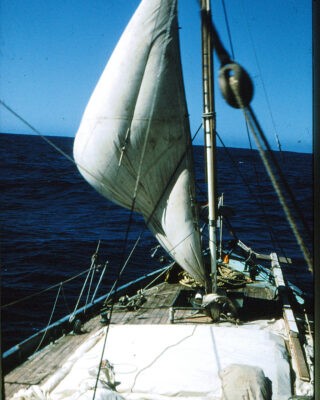

The Smeetons set about making the hull watertight and setting a jury rig
Clearing the chaos

The storm abated the following day, and they were fortunate that the sturdy teak hull had not sprung a leak. Slowly, the chaos was cleared – amongst the casualties was the stuffed blue bear they carried as a lucky mascot. Headless, he was thrown overboard, judged to have been no help at all.

They built a temporary mast to pull up a small sail, along with a steering oar. Mostly Tzu Hang sailed herself though, with just changes to the sails to keep her going in a straight line. Enough navigational equipment had survived for them to take position fixes, along with a pilot book for South America and 23 unbroken eggs. It took almost a week for the cat to dry off and recover her good humour.

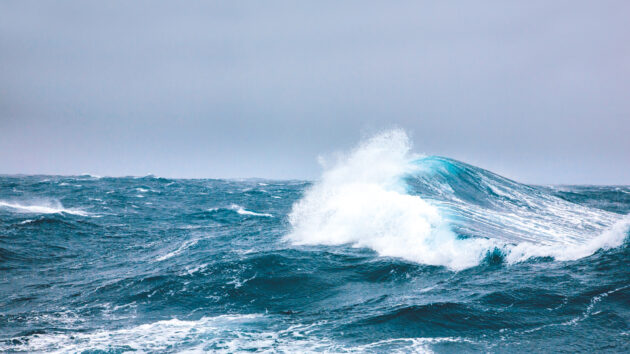
It was not their only encounter with a rogue wave, and Miles Smeeton put himself at odds with the received wisdom of the sailing fraternity of the time when he concluded that there are some waves that a yacht, ‘will be lucky to survive whatever she does.’ These days, such an opinion is mainstream, but prior to Tzu Hang’s experiences, yachtsmen had believed that a well-sailed, well-founded yacht was safe in any deep-water sea. They were wrong. There are rogue waves out there that don’t seem to belong to any ocean or storm, monstrous waves created by some unknown collusion of the elements. ‘With more experience I do not think these waves are so rare,’ commented Smeeton.
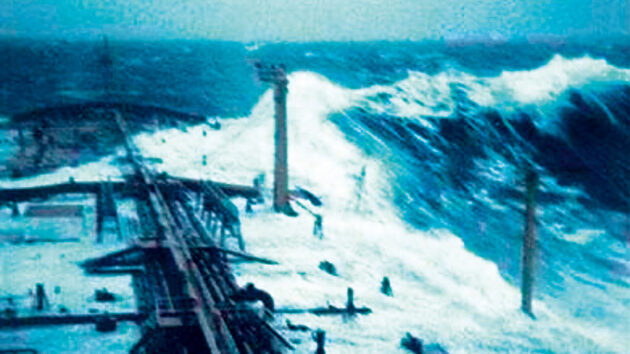

This rare photo of a rogue wave was taken by first mate Philippe Lijour aboard the supertanker Esso Languedoc, during a storm off Durban in South Africa in 1980. The mast seen starboard in the photo stands 25 metres above mean sea level. The wave approached the ship from behind before breaking over the deck, but in this case caused only minor damage. The mean wave height at the time was between 5-10 metres. Photo: ESA Standard Licence
There be monsters

The Smeetons’ experience can teach us something important about risk – that we can’t know all of the risks we face. When Miles Smeeton published his book, it joined a building folklore about rogue waves. There are many accounts of huge waves dotted throughout the logbooks and tales of seafarers, one of the most famous being Ernest Shackleton’s account in his book about the voyage from Antarctica to South Georgia, The Voyage of the James Caird.


Then there was the Esso Languedoc, caught in a storm off South Africa in 1980. Philippe Lijour, the first mate aboard the oil tanker, was fortunate enough to have a camera handy when the breaking crest of a wave roared past, just short of the top of the ship’s cranes some 25m above the waterline.

At the time, Lijour reckoned the average wave height to be somewhere between five to 10m from trough to crest. So where did this monster come from? Despite the stories, oceanographers refused to believe these freak waves existed in any number. Conventional mathematics states that waves should vary in a pattern around the average, called the significant wave height, defined as the mean of the largest third of the waves recorded.
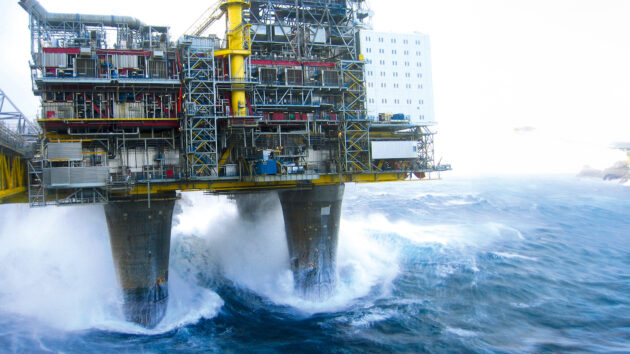

Heaving seas beneath the decks of the Oseberg A oil rig in the North Sea
The new year wave

According to this analysis, in a storm sea of 12m, a 15m wave will pop up about once every 25 years. A rogue wave – one defined as twice that of the significant wave height – is possible, but you’ll have to wait about 10,000 years to see one.

It seemed to the seafaring community that they were appearing a lot more often than that, but the scientists were about as interested in the anecdotal evidence as they were in reports of the Loch Ness Monster. And that’s how things stood until New Year’s Day 1995.

The winds howling down the North Sea had peaked at hurricane force that afternoon, when what’s become known as the New Year Wave roared under the Draupner oil platform just after 1500. It was measured by a laser wave sensor at a maximum height of 25.6m – twice the size of the average wave at the time. Suddenly, the accounts of walls of water approaching at twice the height of the waves around them were no longer so unbelievable.

The immense extra force of these waves did not have good implications for the safety of ships and oil platforms – their design had always been based on the assumptions of conventional mathematics. But the maths was flawed, so the science community went back to its other mainstay: observation.

The EU started up a project called MaxWave, which used images from satellite radar to measure wave height across broad swathes of ocean. In three weeks of images taken from a period and place when two cruise ships had almost been sunk by rogues, it measured ten waves bigger than 25m, which kicked the conventional mathematical models into touch.
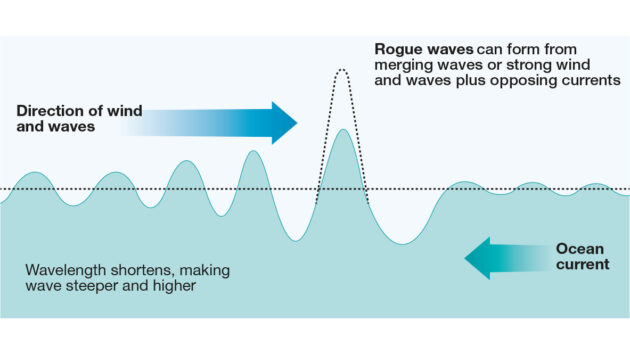

Rogue science

We still don’t have a definitive explanation for why these waves occur. The most likely ones use the same equations as quantum mechanics. It seems that the energy from several separate waves is being focused into just one or two of these monsters, but until theories are better refined, our best chance of predicting these waves is radar tracking.

The research from the MaxWave and subsequent programmes have essentially upended hundreds of years of design assumptions about the conditions that ships will meet at sea. It turns out that a newly built and apparently well-founded, well-prepared ship and crew leaving harbour in 1980 to cross the North Atlantic were in fact not prepared to face the conditions they might encounter.

There is a lesson here for our knowledge of risk – it’s difficult to properly prepare for and mitigate all the risks when we can’t be sure what they are. The Smeetons’ experience was completely unforeseeable at the time.

A rogue wave – of a size that was believed by the planet’s top mathematicians to be physically impossible – appeared from nowhere and rolled their boat, destroyed their home and threatened their lives. Nothing in their experience had given them any expectation of this event, so how could they have been aware of this risk, never mind prepared for it?
The great unknown

Rogue waves happen in many different fields and areas of our lives. Donald Rumsfeld famously labelled them the unknown unknowns in his reply to a journalist’s question in 2002. ‘There are known knowns; there are things we know we know. We also know there are known unknowns; that is to say we know there are some things we do not know.

But there are also unknown unknowns – the ones we don’t know we don’t know…’ because we haven’t thought about them. The question we must consider is whether – and how – we can prepare for the unknown unknowns. Is it even possible to prepare for the implausible, improbable or ‘impossible’?

We can’t plan in any detail for an unknown, unexpected and unpredictable event – but we can plan flexibly, we can be open to the potential for the unexpected and we can prepare for it in some ways. The Smeetons and Guzzwell had a hammer, nails and wood on board Tzu Hang and that was enough to get them through an experience they had no expectation, or comprehension, of when they left Melbourne.

This is what we’re looking for when we’re preparing for something with full appreciation of all the risks, known and unknown – the wood, hammer and nails, the tools that will get us through the unexpected crisis. Remember the Tzu Hang, next time you pack for an adventure.


USA Facts

Demystifying unauthorized immigration to the US

An estimated 11 million unauthorized immigrants were living in the US as of 2022, but the term “unauthorized” covers a lot of ground. It can range from people who have crossed into the country illegally, as well as people who are here lawfully while awaiting an asylum decision. There’s no precise headcount, but here’s what we know from the data.
An unauthorized immigrant is a noncitizen without lawful permanent resident status or a valid visa. They can be people who enter without inspection (meaning they crossed the border between official ports of entry), overstay/violate temporary visa terms, have temporary protections like Deferred Action for Childhood Arrivals (DACA), or are awaiting immigration proceedings. 

Since people who entered without inspection weren’t formally admitted by authorities, we can’t count exactly how many arrive this way. Although Customs and Border Protection apprehension data is one measure of enforcement activity, it doesn’t count the number of people who entered without detection. Monthly apprehensions averaged 8,829 from February 2025 to March 2026. In December 2023, there were 251,178 in a single month.

In fiscal year 2024, the Department of Homeland Security estimated that 1.15% of nonimmigrant visa holders (or 538,548 people, roughly the population of Sacramento, California) had stayed in the US past their visa’s expiration date. 

DACA protects people who were brought here as minors from deportation, but it is not a path to citizenship. In June 2025, there were 515,570 active DACA recipients. That number has gradually declined since May 2018, when it peaked at 702,250.

If the Secretary of Homeland Security determines that a country is unsafe to return to, citizens of that country who are already in the US can apply for Temporary Protected Status. As of March 2025, nearly 1.3 million people in the US had this status.

See the data
America’s biggest trade partners, by the numbers

Global trade might sound sprawling, but for the US, it’s surprisingly concentrated. The US has trade relations with over 200 countries, but in 2024, 48% of all US trade was with just six of them.
Mexico, Canada, and China were the nation’s top trading partners every year from 2004 to 2024, only moving ranks between each other. The same was true for the United Kingdom, Germany, and Japan, which ranked fourth through sixth.
In 2024, Mexico, Canada, and China accounted for 34.2% of total trade and $2.5 trillion in trade value.

The US imported most goods and services from Mexico, Canada, China, Germany, and Japan in 2024, each valued at over $190 billion. Combined, these five countries accounted for 46% of US imports.

The US exported the most goods and services to Europe ($998.0 billion) and the Asia and Pacific region ($875.5 billion). The countries that received the most US exports were Canada, Mexico, China, the United Kingdom, and Japan, each valued at $129 billion or more. These five countries accounted for 41% of exports.
See the data
These are the facts you’re looking for

We’ve improved the search at USAFacts! Need a quick answer to a data question? Now you can get an AI overview answer right away before clicking into any of our articles.

These are responses you can trust: All the information comes exclusively from hundreds of articles and thousands of datasets at USAFacts. Want to check out the data for yourself? Great! Search will always provide the article from which it pulled its numbers. Visit our search page to get started.

Data behind the news
Readers have been asking, “If the United States is a net exporter of oil, why are gas prices rising?” The answer: it’s priced globally and the cost is intertwined with social and economic events. This article from our archives has more information.

The Senate Banking Committee has scheduled a hearing for Kevin Warsh, President Trump’s pick for the next Federal Reserve chair, on April 21. Here are some questions we want Congress to ask.

It’s time again for a weekly fact quiz!

One last fact

The Consumer Price Index tracks two inflation measures: headline and core. Headline inflation tracks specific consumer spending subsets including food, housing, and energy. Core inflation tracks most of those categories, just minus food and energy because those categories tend to have volatile price swings.

While the headline inflation rate was 3.3% in March, the cost of fuel oil and other fuels increased by 22.9% compared to the previous year. Meanwhile, egg prices dropped 44.7%.

As for core inflation items, public transportation prices increased the most, 10.2%. Health insurance fell the most (-5.3%).

$1,200 barista bonuses


A Starbucks barista serves a coffee that has "Hello Again!" written on the paper cup.

Starbucks

This really puts the “bucks” in Starbucks, folks. In a letter to staff, Starbucks announced that hourly workers are now eligible for up to $300 in bonuses per quarter (or $1,200 a year) if their coffeehouses meet certain sales and customer service goals:

  • Sbux is also expanding tipping options and paying staff weekly, instead of every other week.
  • The changes will amount to a pay raise for baristas of 5% to 8% on average, Starbucks said.

The movie is part of a strategic overhaul under CEO Brian Niccol to incentivize staff to improve customer satisfaction, with the ultimate goal of reviving stagnant sales and showing investors that its best days aren’t behind it.

It’s unclear how workers can procure the customer service bonus, but we assume it starts with ensuring all Ericas with a “c” get the correct consonant written on their cups.

Southwest Is About to Limit Power Banks on Flights

 Southwest Is About to Limit Power Banks on Flights


Southwest Is About to Limit Power Banks on Flights
External chargers can spontaneously combust, creating flames that are tough to put out.
BY ECE YILDIRIMPUBLISHED APRIL 12, 2026, 4:58 PM ET

READING TIME 2 MINUTES

External chargers aren't so handy when they're on fire, are they? © Edward Berthelot/Getty Images
READ LATER COMMENTS (14)


Southwest Airlines will soon start capping how many portable chargers and power banks you can bring on a flight, according to an internal message obtained by the New York Times.

According to the report, starting April 20th, passengers will only be able to bring one lithium battery-powered portable charger per person to a flight, and they won’t be allowed to charge those portable chargers using in-seat power, nor will they be able to store them in the overhead bins. Instead, passengers will be asked to hold their portable chargers throughout the flight or store them in a carry-on bag under their seats.

Lithium batteries power much of the technology we use in our day-to-day lives, from phones to laptops to e-cigarettes. They are also found in portable chargers and power banks.

Most of the time, they work fine, but if they are damaged, overcharged, or overheated, then the batteries can catch fire. Due to the chemicals inside these batteries, the flames they can create could be very tough to extinguish.


Due to this risk, portable chargers were long banned from checked baggage, with airlines requiring passengers to put portable chargers and any other lithium battery-powered devices inside their carry-on bags instead.

But still, there were 97 lithium battery-related incidents in aviation in 2025, and there have already been 14 accidents this year, according to the Federal Aviation Administration. The majority of the lithium battery-related air incidents that involved smoke, fire or extreme heat stemmed from portable chargers. The second biggest culprit was e-cigarettes, according to the FAA data.

The most high-profile recent incident was in January 2025, when an Airbus plane went up in flames on the tarmac at an airport in Busan, South Korea. Everyone on board had to evacuate, and the fire took roughly an hour to extinguish. Authorities later concluded that a power bank stored in an overhead bin may have been the culprit. A few months later, an Air China flight had to make an emergency landing when a lithium battery in an overhead bin spontaneously combusted mid-flight.

Chinese regulators have banned portable batteries from flights altogether, except if the device is clearly marked with a Chinese safety certification and has not been subject to recalls. Many airlines internationally have also since banned passengers from using or charging portable chargers, but Southwest is so far the only major American airline to come out with an even stricter set of rules for portable chargers.

One way that you can protect yourself against these spontaneous fires is to keep a close eye on product recalls. Anker, one of the world’s leading power bank makers, has issued several recalls over the past year due to potential fire risks.

You might not be going anywhere this summer


Americans rethinking international summer travel due to high gas prices

Bertrand Guay/Getty Images

Lizzie McGuire would be closing out her class trip at the Hard Rock Casino Cincinnati in this economy. Americans are sitting in limbo for summer travel plans as potential jet fuel shortages stemming from the Iran war put pressure on airlines to cut flights and raise airfares.

As the most famous strait (aside from George) remains closed to much of the world’s oil, the global travel industry is bracing for a potentially chaotic summer. Delta said that jet fuel costs ballooned by $400 million in March alone. Alaska Air, American, and United have repeated similar warnings:

  • Average global airfares jumped 24% to $465 on the week beginning March 9, compared with the same time last year, according to airfare tracker OAG.
  • Transatlantic flight tickets 20 days out already cost $200 more on average than they did a month ago, a Deutsche Bank AG analysis found.
  • United said it’s cutting ~5% of its flights in “off-peak periods” during the next two quarters to offset rising expenses.

As a result, the share of Americans planning international trips over the next six months fell to 17%—the lowest it’s been since 2022, per the Conference Board.

Not even Spirit can save you. Budget airlines with thinner margins are the highest risk when industry costs surge, so budget trips could also face steep fare hikes. Ryanair CEO Michael O’Leary refused to rule out price increases, saying the UK is more vulnerable to jet fuel shortages than other European countries because it relies on Kuwait for nearly 25% of its supply.

What about a road tip? A cruise? Unless you were planning on biking, no form of summer travel is immune to rising oil prices. Gas topped $4 a gallon this week for the first time in two years, and cruises face similar fuel crunches. Analysts worry that Carnival, the only US cruise line that does not hedge fuel, could take a huge hit to its profits this year.

Tim Cook steps down as Apple CEO


Maine is poised to freeze large data-center construction


Maine Is About to Become the First State to Ban New Data Centers

Legislation that could be enacted this spring would pause construction of large new data centers until November 2027

 ET

An ambulance arrives at the Androscoggin Mill after an explosion at the paper mill in 2020.
At the site of an old paper mill in Jay, Maine—seen here in 2020—construction of a data center is expected to get under way in July. ROBERT F. BUKATY/AP

Maine is poised to freeze large data-center construction, which would make it the first state to enact such a measure as communities across the U.S. grapple with fallout from the boom in artificial intelligence.

The Maine bill calls for a ban on major new data-center construction until November 2027, so the state can assess the impact of such development on the environment and electricity grid.

The freeze would apply to data-center projects of at least 20 megawatts, which is enough energy to power more than 15,000 homes.

The bill passed a floor vote in the Democratic-controlled Maine House of Representatives last month, collecting a handful of Republican votes. It is expected to pass in the Senate, which is also majority Democratic. Gov. Janet Mills said she supports a freeze.

Democratic Gov. Janet Mills shaking hands with a lawmaker.
Maine’s Democratic Gov. Janet Mills said she supports a moratorium if it includes an exception for the project already planned in Jay. ROBERT F. BUKATY/AP

Maine has some of the country’s highest residential electricity prices, and elected officials are concerned that a surge in data-center power demand might further inflate costs. The AI build-out is driving up electricity costs for consumers in some parts of the country, and at the same time generating large tax revenues for local governments that continue to court developers.

The bill’s momentum will be watched closely by lawmakers in at least 10 other states that are advancing similar policies over concerns about straining local power sources and the cost. The effects of the artificial-intelligence race on the economy, energy costs and the environment is emerging as a major issue ahead of this year’s midterm elections. In Maine, a U.S. senate seat is up for grabs in November.

“I think Maine is the canary in the coal mine,” said Anirban Basu, chief economist for the Associated Builders and Contractors, a construction trade group that counts members who work on data centers. “Maine will be the first of many states to have such moratoria.”

Legislators have introduced measures to temporarily ban or restrict data centers in New York, South Carolina, Oklahoma and other states. In Ohio, one of the top states for data-center development, a group of rural activists is collecting signatures to put a statewide ban of large data centers on a November ballot.

Many other municipalities and counties, especially small ones in Michigan and Indiana, already have imposed their own temporary pauses. Denver and Detroit are among major cities considering such bans.

Data-center developers are growing increasingly wary of community and political opposition as they hunt for powered land across the country. Proposed local laws restricting data centers are “a red flag,” said Tracey Hyatt Bosman, a site selection consultant at BLS & Co. who works with data-center developers. “They do limit where we are looking,” she said.

Tony McDonald, who is developing a data center in the western Maine town of Jay, said he is scheduled to begin construction in July. “All of a sudden we’ve been caught in this dragnet,” he said.

Maine hasn’t been a magnet for Alphabet’s Google, Microsoft or other companies building hyperscale facilities for artificial intelligence. Recent data-center proposals in the Maine towns of Wiscasset and Lewiston were paused or failed at the local level, following resident opposition.

Some data-center developments in Maine have targeted defunct industrial sites, such as closed mills. One company recently proposed to build a $415 million underwater data center off Maine’s coast.

While it is possible the Maine moratorium bill could stumble in the amendment process, that a version of it eventually becomes law is a foregone conclusion among some state political operatives.

“That’s the political reality,” said Tony Buxton, a climate and energy attorney at Preti Flaherty, a legal and lobbying firm in Maine. “There is a very strong voter fear of data centers and AI.” 

Buxton’s firm has placed ads on social media advocating exemptions in the bill that would allow two already planned data-center projects to move forward in Jay and in Sanford, which is in southern Maine. These exemptions are being considered in the House.

Gov. Mills, a Democrat who is running for U.S. Senate in a highly publicized primary race against Iraq war veteran Graham Platner, said she supports the data moratorium if it includes an exception for the project already planned in Jay.

“The project is expected to bring much-needed jobs, economic activity and tax revenue to the region,” a spokesman for Mills said in a statement.

In the U.S. Congress, Sen. Bernie Sanders (I., Vt.) and Rep. Alexandria Ocasio-Cortez (D., N.Y.) last month unveiled legislative proposals to temporarily pause data-center construction nationwide.

RG Richardson Communications News

I am a business economist with interests in international trade worldwide through politics, money, banking and VOIP Communications. The author of RG Richardson City Guides has over 300 guides, including restaurants and finance.