Sign up today

Softphone APP for Android &IOS
The TrumpRx launch
The TrumpRx launch. On Thursday, the Trump administration rolled out TrumpRx, a government website offering consumers discounted prices for common prescription drugs. The platform functions as a hub for consumers, connecting them to manufacturers’ sites or offering coupons for purchases at pharmacies. President Donald Trump said TrumpRx will create millions in consumer savings, with those savings likely concentrated among the uninsured.
Back up: In September, President Trump announced TrumpRx as part of a series of initiatives to bring down prescription drug costs. In the first year of his second term, the president negotiated agreements with several major pharmaceutical companies to sell their products at lower prices in the U.S., in some cases pegged to the prices they charge in other countries (known as Most-Favored Nation pricing). Prior to striking those deals, Trump threatened to cap how much drug manufacturers could earn from Medicare if they did not agree to lower prices.
TrumpRx had 43 drugs listed at launch, with savings between 33% and 93% off the list price. In a Thursday post, the White House highlighted examples of the expected price reductions for common medications. It said the monthly cost of GLP-1 medications like Ozempic will drop from $1,028 to an average of $350, while fertility drugs like Gonal-F will drop from $966 to $168 on average. It also said that additional drugs will be added to the site as Trump negotiates additional deals with manufacturers.
“Americans have long been paying the highest drug prices anywhere in the world, while other countries often paid pennies on the dollar for the exact same drugs,” President Trump said on Thursday. “Under the agreements my administration has negotiated, the United States will pay the lowest price paid by any other country.”
Some healthcare experts have questioned how many consumers will benefit from the savings. In many cases, the list prices on TrumpRx are higher than what insured patients pay for the same prescription, even with the significant discount applied. As such, the savings may be limited to those without insurance, particularly if insured consumers are not able to count the cost of drugs purchased through the site toward their deductible or out-of-pocket maximum. Currently, TrumpRx only offers discounted pricing to consumers paying in cash.
Today, we’ll break down the TrumpRx launch, with views from the right, left, and health policy experts. Then, Managing Editor Ari Weitzman gives his take.
What the right is saying.The right is mixed on TrumpRx, with many saying it delivers on the president’s promise to lower drug costs.
Others argue the site subverts free-market principles.
In PJ Media, Matt Margolis wrote “Trump reduces medication costs, and the left isn’t happy.”
“Democrats love talking about affordability, but they rarely follow through. If they genuinely cared about bringing down drug costs, they’d be applauding President Trump’s latest effort to slash prescription drug prices. Instead, they’re attacking him,” Margolis said. “[TrumpRx] promises to deliver massive savings on medications, including wildly expensive weight loss drugs like Ozempic and Wegovy… In every sense, it achieves something that Democrats have talked and talked and talked about, but never succeeded in doing.”
“For decades, American patients have been subsidizing drug costs for Europeans and their so-called ‘free’ healthcare systems. Europeans typically pay far less for new medications than Americans do, which means that U.S. patients should theoretically benefit from Trump's pricing changes,” Margolis wrote. “So why is the left more outraged over the fact that Trump’s program is causing prices to go up in other countries than the fact that the Americans have been subsidizing socialized medicine abroad?”
In Reason, Marc Oestreich called the new site “Obamacare in Trump’s handwriting.”
“For most people, the ‘discounts’ aren't really discounts. Roughly 90 percent of Americans are insured, and their co-pays are almost always cheaper than TrumpRx’s cash prices. Medicaid patients already get the steepest rebates — more than 60 percent off by law — so TrumpRx adds little there,” Oestreich said. “All of this bypasses the way Americans actually get prescriptions. CVS, Walgreens, and the rest are cut out entirely, replaced by a federally branded coupon pop-up that punts you to a manufacturer’s checkout page. TrumpRx looks like a deal, but in practice, it helps almost no one.
“If this sounds familiar, it’s because the blueprint was drawn a decade ago. Washington shoved through the Affordable Care Act (ACA) with the same central-planning arrogance, resting on monopolistic dealmaking and government-dictated price regulation,” Oestreich wrote. “TrumpRx employs the same toolkit: One company receives favorable treatment, the government demands discounts in exchange for tariff protection, and Washington exerts raw power with no regard for the consequences. This leads to squeezed margins, less research, smaller generic drugs being driven out, and higher prices in the long run.”
What the left is saying.The left is skeptical of TrumpRx’s value, with some noting it only covers a small number of drugs so far.
Others say the logic of Trump’s approach to drug pricing is flawed.
In The Atlantic, Nicholas Florko described “the real winner of TrumpRx.”
“The big winners of yesterday’s announcement seem to be not patients, but drug companies. The Trump administration got drugmakers to the negotiating table last year by writing letters to the companies threatening to ‘deploy every tool in our arsenal to protect American families from continued abusive drug pricing practices,’” Florko said. “Drugmakers were able to turn the threat into a PR opportunity: When Pfizer cut a deal to participate in the program, the company’s CEO, Albert Bourla, was brought to the West Wing, where Trump called the drug company ‘one of the greatest in the world.’
“Drug companies have also successfully protected their ability to charge whatever they please for some of their biggest moneymakers… many of the pharmaceutical industry’s best-selling products — some of which also are among their more expensive offerings — are absent from the website,” Florko wrote. “Take Keytruda, Merck’s cancer drug that was the world’s best seller until it was recently surpassed by the weight-loss and diabetes injection tirzepatide: That drug retails for roughly $12,000 for a three-week course of treatment, and it is missing from TrumpRx. Of the top 10 best-selling prescription drugs in 2024, only one — Ozempic — is listed on TrumpRx.”
In Bloomberg, Lisa Jarvis said “the push for lower US drug prices uses bad logic.”
“In exchange for tariff relief, companies agreed to match Medicaid prices to those paid by peer countries, to invest in research and manufacturing in the US, and to sell certain drugs at a discount on… TrumpRx,” Jarvis wrote. “That might sound like a win for patients and taxpayers. But… the lack of concrete details about the benchmark being used — the prices paid by other countries are confidential — makes it nearly impossible to evaluate the deals. Earlier legislation is already working to reduce Medicaid drug costs, meaning the US might already be getting a better deal than its peers.”
“It’s also easy to imagine how countries and companies could game the system. Manufacturers, for example, could raise list prices abroad, making the benchmark the US uses appear higher, while quietly offering backdoor discounts,” Jarvis said. “None of this is to suggest that the astronomical cost of health care in the US or the system’s emphasis on treatment over prevention aren’t problems in desperate need of fixing. Rather, it is to say that we should price drugs based on the system in which they are delivered. That would require developing a thoughtful, transparent process for evaluating the cost-effectiveness of drugs — something peer nations with lower prices already have.”
What health policy experts are saying.Some experts say government intervention in drug costs risks driving up prices.
Others suggest TrumpRx’s out-of-pocket payment requirement will hurt those it intends to help.
In Cato, Jeffrey A. Singer wrote “TrumpRx: when government tries to build a market.”
“Third-party payment arrangements tend to drive up drug prices. When insurers or government programs are paying most of the bill, patients have little incentive to resist high prices,” Singer said. “In fact, they often push back when payers try to steer them toward lower-cost drugs or pharmacies because any savings go to the insurer, employer, or government — not to them. Insurers, for their part, know that denying coverage or refusing to pay list prices can cause backlash from beneficiaries who feel entitled to whatever their plan covers.”
“Injecting government into this space risks crowding out private innovation and inviting the familiar problems of political favoritism, coercion, and regulatory corruption,” Singer wrote. “If the administration wants to expand direct-to-consumer drug purchasing, the most effective role it can play is not to build a federal platform but to eliminate policy barriers that hinder private actors from competing, innovating, and lowering prices on their own… [TrumpRx risks] substituting political allocation for consumer choice in a space that is only now beginning to function like a real market.”
In STAT, Sean D. Sullivan and Ryan N. Hansen said “TrumpRx has a fundamental flaw.”
“The promise is seductive: lower prices on brand-name medications, available to anyone willing to bypass their insurance and pay out of pocket. But for most Americans, this initiative represents not a solution to our prescription drug price dilemma, but rather a distraction from it,” Sullivan and Hansen wrote. “The fundamental flaw in the TrumpRx model lies in a misunderstanding — or perhaps a willful misrepresentation — of how most Americans pay for their prescription medications. Most insured people pay far less out of pocket when using their insurance coverage than they would by paying ‘discounted’ cash prices, even when those prices are subsidized by manufacturers.”
“Consider a common but hypothetical scenario for older Americans: A patient with diabetes and high cholesterol needs two brand-name medications: Januvia and Repatha. Through insurance, they might pay a $35 copay for each drug per month ($840 per year). The TrumpRx website will offer Januvia for diabetes at $100 per month and Repatha for cholesterol management at $239 per month — a ‘discount’ from existing manufacturer list prices of $330 and $573 per month, respectively ($4,068 per year),” Sullivan and Hansen said. “Paying cash requires an additional $3,228 out-of-pocket, or nearly 6% of their total income. For seniors already choosing between medications and groceries, this isn’t a discount. Using TrumpRx would represent the equivalent of a tax on those least able to afford it.”
My take.
Reminder: “My take” is a section where we give ourselves space to share a personal opinion. If you have feedback, criticism or compliments, don't unsubscribe. Write in by replying to this email, or leave a comment.TrumpRx makes some fertility treatments and GLP-1s much more affordable.
For most people, the new government website will do nothing.
With complicated approvals and patent protections, drug pricing is really complicated — and any step towards affordability should be celebrated.
Managing Editor Ari Weitzman: There’s an old saying about drug pricing that goes like this: “It costs the drug company five cents to make each pill, but it costs them $2 billion to make the first one.” At the end of the day, a legislative framework that finds a way to offer fair prices to consumers under that dynamic is simply going to be complicated, and any step forward should be celebrated. TrumpRx doesn’t help most people in general, but it will help people who need GLP-1 drugs and fertility medication when those treatments aren’t covered by their insurance, and we should celebrate that.
That’s the bottom line. Any other claims are noise.
But why GLP-1 and fertility drugs? Out of all the discounts TrumpRx is offering, how does the benefit get narrowed down to only a few options for only certain people?
Let’s start with what TrumpRx is, which I think Forbes’s Jesse Pines summed up best (emphasis added): “TrumpRx is not a government-run pharmacy. Instead, it’s a centralized directory and coupon generator that connects cash-paying patients to pre-negotiated manufacturer discounts on 43 specific brand-name drugs.” And now let’s unpack each of those four emphasized elements.
First, pre-negotiated manufacturer discounts. This is important context for making sense of drug prices: Drug companies sell their product for a “list price,” which — frankly — is a gratuitous sham. Based on exclusivity or perceived value, pharmaceutical companies charge whatever they want for their drugs, then negotiate those prices down through considerable discounts to pharmaceutical benefit managers (PBMs). This process obfuscates the true “net price” insurance providers pay for these drugs, and often leaves uninsured people paying exorbitant prices that effectively serve as added profit margin for manufacturers. So, if you are uninsured and looking for a prescription drug, TrumpRx may provide a benefit.
Second, cash-paying patients. What if you’re insured? If you have insurance, and your insurance covers the medication you need, then that’s it — TrumpRx probably won’t offer you any better price than what you get through insurance. If your insurance doesn’t cover a drug you want or need, that’s a different story. Just under 85% of Americans have some form of prescription drug coverage, and about 80% of drugs are covered by those plans. The prescription drugs most commonly not covered by insurance are those prescribed for weight management, sexual dysfunction, hair growth, and fertility. If that’s your situation, then TrumpRx may provide a benefit to you, too.
Third, the 43 drugs TrumpRx covers. TrumpRx discounts come in one of two ways: negotiated discounts to manufacturer prices or coupons to be presented at pharmacies. For example, I take an albuterol inhaler for occasional asthma. The TrumpRx offer for their covered name-brand albuterol inhaler, AstraZeneca’s Airsupra, shows how I can buy an inhaler from AstraZeneca for a helpful 60% reduction of $201 from its extortionist list price of $503.93. I don’t even need TrumpRx for that price; I can go straight to the website and receive the discount that the government negotiated. Other drugs have rebates in the form of printable coupons: If I want Pristiq to help treat depression, I can print out a 54%-off coupon, get a prescription for the drug from my doctor, and go to a pharmacy and receive this discount off the list price. But I have better options for both of these cases.
Fourth, name-brand drugs. Most drugs offered through TrumpRx are available through generic alternatives. Pristiq’s generic form, desvenlafaxine, is available for about $30, and I can get a generic albuterol inhaler for under $50 (if not better) with a similar coupon through GoodRx. I’d have to be severely underinformed to choose instead to go through the manufacturer (though, happily, I’m one of the 85% of Americans with health insurance coverage, and albuterol is one of the 80% of drugs covered by my insurer). For almost all the other drugs offered through TrumpRx, generics beat out the discounted prices. So that leaves two kinds of drugs that I can get cheaper from the government website than through other alternatives (unless I have really good insurance coverage): fertility drugs and GLP-1s.
But that’s still not the whole story. To get us the rest of the way there, I need to expound on our coverage of the Biden administration’s Medicare Part D negotiations in 2023. We missed an important piece of context in our coverage that has haunted me for years, and providing that context from three years ago helps provide a fuller picture today.
Essentially, Medicare was able to negotiate down the prices for 10 drugs — including diabetes treatments, cancer treatments, and blood thinners — for people covered by Medicare Part D, thanks to a rule passed in the Inflation Reduction Act (IRA) allowing the government to negotiate prices. We focused on how much these changes would actually help consumers, whether “price-fixing” was a better word than “negotiating” to describe the changes, and what externalized costs would come from bringing these prices down. All of those were good aspects to cover.
We didn’t explore why these 10 drug prices were coming down without much of a fight from pharmaceutical companies. The IRA said that Medicare could negotiate the prices of the 10 most expensive drugs in the program in 2023, but only the ones that had already been FDA-approved for a long time — 7 years for small-molecule (chemical) drugs and 11 years for biologics (derived from living organisms). FDA exclusivity regulations and patents protect pharma companies from competitors — for five years after approval for small-molecule drugs and 12 years after approval for biologics. Usually these protections get extended, meaning the IRA really took a few years of maximal profitability off the drugs covered by the law.
Later this year, the next 15 most expensive drugs with nearly expired patents will be negotiated for Medicare Part D or B to take effect in 2028, then another 20 will be negotiated in 2029. Those Medicare wins are time-limited, since generics will soon come to market to beat out those prices. The discounts offered for GLP-1 and fertility drugs through TrumpRx are similarly time-limited — however, and importantly, that bill’s due date is much further out.
For GLP-1s, the semaglutide (Ozempic and Wegovy) patent expires in 2026. A Brazilian alternative is currently facing the long FDA approval process, but secondary patents will inhibit the availability of generic semaglutide in the U.S. market until the early 2030s. Meanwhile, tirzepatide (Mounjaro and Zepbound) is patent-protected through the late 2030s.
As for fertility treatments, many drugs used to help stimulate gamete production aren’t available in the United States through generics or biosimilars — despite the fact that patents aren’t restricting their development. In particular, recombinant HCG (Ovidrel) and FSH (Gonal-F) have competitors in Europe but not in the U.S. TrumpRx offers Gonal-F for $168, an incredible savings of about $1,800 over its availability through GoodRx. It also offers Cetrotide, name-brand cetrorelix acetate, which is already available as a generic. However, the TrumpRx pricing offers another strong discount over what you can get in the market, slashing the price from about $200 to $20.
For people who will be helped by GLP-1 medication and fertility drugs, insurance often doesn’t provide much savings, and these discounts through TrumpRx will be an enormous benefit. Maybe, in the future, other drugs will fall under that umbrella; but for now, the new government site takes a small bite out of the enormous health care affordability problem in the United States. That isn’t a monumental achievement, but it is a step forward. And that’s worth appreciating.
Take the survey: What do you think of TrumpRx? Let us know.
Disagree? That's okay. Our opinion is just one of many. Write in and let us know why, and we'll consider publishing your feedback.
Milliard seeks buy-in for Liberal brand of federalism
PLQ leadership front-runner Milliard seeks buy-in for Liberal brand of federalism
Sherbrooke Record · 25 days ago
by Matthew Mccully · News
Ruby Pratka
The Record – LJI
With one month to go before the deadline for Quebec Liberal Party (QLP) candidates to put their names forward, two months before a leader is named and ten months before the next general election, a clear frontrunner has emerged, and he lives in the Townships.
North Hatley resident Charles Milliard, who finished a close second in the race that saw Pablo Rodriguez become party leader last summer, is the first and so far the only would-be leader to officially file his candidacy, and he has already received the support of most of the party’s 18 MNAs. He plans to run in the riding of Orford.
Milliard is a licensed pharmacist, a former executive at the Uniprix pharmacy chain and the public relations firm National, and the former head of the Fédération des chambres de commerce du Québec (FCCQ). Before stepping down to focus on his campaign, he was executive-in-residence at Bishop’s University. Assuming he wins the leadership, he faces an uphill battle rebuilding the QLP’s support outside of Montreal and threading the needle between winning back the support of nationalist francophone voters who have shifted to the Coalition Avenir Québec (CAQ) over the last decade, and assuaging the concerns of anglophones and committed federalists about the Parti Québécois (PQ) push for sovereignty. “Unfortunately, my opponent is always bringing the discussion back to identity and separation. I’m going to have to have very clear answers about that. But this is not the reason I’m getting into politics. The reason is economy, health care, education, culture and so on.” He also hopes to “bring more kindness into politics.”
Milliard, 46, joined the QLP at 18 and has been a member for his entire adult life; he said he was a member of the federal Progressive Conservative party in the 1990s but began supporting the federal Liberals when the Conservatives shifted further to the right. Although he has never held elected office, he said the QLP has always been his “political family.”
He left his position at the FCCQ in 2024 to tour the province and run for the Liberal leadership. After finishing second to Rodriguez, he was named executive-in-residence at Bishop’s – a “true privilege” which gave him the opportunity to work in English and see the higher education system from the inside out.
Sherbrooke Record · 25 days ago
by Matthew Mccully · News
Ruby Pratka
The Record – LJI
With one month to go before the deadline for Quebec Liberal Party (QLP) candidates to put their names forward, two months before a leader is named and ten months before the next general election, a clear frontrunner has emerged, and he lives in the Townships.
North Hatley resident Charles Milliard, who finished a close second in the race that saw Pablo Rodriguez become party leader last summer, is the first and so far the only would-be leader to officially file his candidacy, and he has already received the support of most of the party’s 18 MNAs. He plans to run in the riding of Orford.
Milliard is a licensed pharmacist, a former executive at the Uniprix pharmacy chain and the public relations firm National, and the former head of the Fédération des chambres de commerce du Québec (FCCQ). Before stepping down to focus on his campaign, he was executive-in-residence at Bishop’s University. Assuming he wins the leadership, he faces an uphill battle rebuilding the QLP’s support outside of Montreal and threading the needle between winning back the support of nationalist francophone voters who have shifted to the Coalition Avenir Québec (CAQ) over the last decade, and assuaging the concerns of anglophones and committed federalists about the Parti Québécois (PQ) push for sovereignty. “Unfortunately, my opponent is always bringing the discussion back to identity and separation. I’m going to have to have very clear answers about that. But this is not the reason I’m getting into politics. The reason is economy, health care, education, culture and so on.” He also hopes to “bring more kindness into politics.”
Milliard, 46, joined the QLP at 18 and has been a member for his entire adult life; he said he was a member of the federal Progressive Conservative party in the 1990s but began supporting the federal Liberals when the Conservatives shifted further to the right. Although he has never held elected office, he said the QLP has always been his “political family.”
He left his position at the FCCQ in 2024 to tour the province and run for the Liberal leadership. After finishing second to Rodriguez, he was named executive-in-residence at Bishop’s – a “true privilege” which gave him the opportunity to work in English and see the higher education system from the inside out.
-Feb-09-2026-03-05-46-6541-PM.png?width=1120&upscale=true&name=unnamed%20(1)-Feb-09-2026-03-05-46-6541-PM.png)
-Feb-09-2026-03-06-48-0528-PM.png?width=1120&upscale=true&name=unnamed%20(2)-Feb-09-2026-03-06-48-0528-PM.png)
The world’s most famous fountain is no longer free

Niv Bavarsky
It now costs two euros (~$2.35) to visit Rome’s treasured Trevi Fountain—not including the three coins you’ll have to toss to marry a local, as the superstition goes. In a bid to tame crowd chaos, the city started charging tourists a fee this week to access the ornate sculptural fountain featured in Federico Fellini’s film La Dolce Vita and the Instagram story of every Roman holidayer. Additionally, there’s now a five-euro charge for some city museums. Still worth itThe city says it’s not trying to deter visitors, but rather aims to raise a projected $7.6 million yearly to fund historic preservation and crowd control efforts at the site, insisting that two euros is peanuts for the chance to behold the Baroque-era marble masterpiece. A local official conjectured that if the fountain were located in New York, it would cost “at least $100.” But there are still two ways to visit Italy’s landmark water spewer for free: Go after 10pm, or relocate to Rome permanently, since locals are exempt. Rome isn’t alone…in combating overcrowding by tourists. Paris recently hiked the Louvre’s ticket price for non-Europeans from $26 to $37, while Venice imposed a daily five-euro city visit fee. |
1 in 9 CEOs were replaced last year

Jessica Rinaldi/Getty Images
A chill just ran through your company’s nicest corner office, and it’s not because the custodian left the window open overnight. According to a Wall Street Journal analysis, about one in nine CEOs was replaced among 1,500 of the biggest public companies last year:
Companies have cited a potpourri of reasons for their c-suite swaps, from AI to tariffs to economic and geopolitical uncertainty. They’re turning to younger (and greener) execs to fix their problems: Per the WSJ, incoming CEOs are 54-years-old on average, while more than 80% of last year’s crop were first-timers. |
Quebec keeps 33% tuition hike for out‑of‑province students after court ruling
Quebec keeps 33% tuition hike for out‑of‑province students after court ruling
The province will not go back to court to seek approval of the rewritten rules, a Higher Education Ministry spokesperson said.
Author of the article:By Andy Riga
Published Feb 02, 2026Last updated 16 hours ago
3 minute read
 McGill (above) and Concordia have cited the tuition increase for non-Quebec students, which caused a drop in out-of-province applications, as a key reason why they have been compelled to make deep budget cuts. Photo by John Mahoney /Montreal Gazette
Quebec is keeping a 33 per cent tuition increase for non‑francophone students from outside the province, saying its revised university funding policy complies with a Quebec Superior Court ruling that found the hike “unreasonable.”
In the April 2025 ruling, Justice Éric Dufour invalidated the hike as drafted but gave the province nine months to update its framework.
In an updated policy published late last month, the province explained the rationale behind the tuition increase, which mainly affected Concordia and McGill, both of which are English universities.
The document now “specifies that the tuition increase aims to prevent Quebec taxpayers from having to largely subsidize the studies of Canadian students who are not recognized as Quebec residents,” Higher Education Ministry spokesperson Bryan St-Louis told The Gazette on Monday.
A preferential tuition rate continues to be available to out-of-province students who choose to pursue their university studies in French, “with the goal of positioning Quebec as a leading francophone destination,” St-Louis said.
In 2024, Quebec hiked tuition for new out-of-province students studying in English by 33 per cent — making it about $12,000, up from $9,000. The Legault government said the increase was meant to protect the French language and curb the number of non-French-speaking students in the province.
McGill and Concordia sued the Quebec government, arguing that the hike was unreasonable and discriminatory. They have cited the tuition changes, which caused a drop in out-of-province applications, as a key reason why they have been compelled to make deep budget cuts.
In his judgment, Dufour criticized the arguments advanced by former higher education minister Pascale Déry, echoing the universities’ contention that the plan was put forward without sufficient evidence.
Article content

Concordia spent $780,000 on legal fight over Quebec tuition overhaul

Academic freedom at risk with constitution bill, Quebec universities warn
The judge also ordered the province to immediately scrap its plan to impose French proficiency requirements for non-Quebec applicants. At the time, Déry’s spokesperson said the province would “be pursuing discussions” on the issue of knowledge of French for students from outside Quebec.
When the judgment was handed down, Concordia University president Graham Carr said he hoped the court ruling would be a wake-up call for Quebec to work with English universities.
However, Quebec said it would maintain the tuition hike, without providing details on how it would proceed.
St-Louis, the ministry spokesperson, said on Monday that Quebec will not go back to court to seek approval of the rewritten rules. He said the province is not obliged to “present the budgetary rules in their modified version to a court following the judicial decision.”
Concordia spokesperson Vannina Maestracci said the university is “disappointed but not surprised” by the government’s stance.
“We regret that despite facts, figures, the opinion of a (government-mandated) specialized committee on the issue and a ruling by the Quebec Superior Court, the government is sticking with a measure that harms the competitiveness of all Quebec universities.”
She said Concordia is scheduled to meet soon with Higher Education Minister Martine Biron, at which time the university will raise “this and other measures that continue to damage the province’s reputation as a university destination.”
McGill declined a request for comment.
Many Quebec students study in other provinces. For example, in 2024, about 6,400 Quebec students were in Ontario universities — roughly the same number going in the other direction, according to an analysis by Higher Education Strategy Associates.
With some exceptions, Quebec students studying in the rest of Canada pay the same amount as locals.
In 2023, McGill noted that the planned $12,000 rate for out-of-province students would price Quebec out of the market in the arts and sciences programs that welcome most students from elsewhere in Canada.
“Put yourself in the shoes of a student from the rest of Canada — ($12,000) is still double what you’re going to pay at the University of Toronto or the University of British Columbia,” a McGill official said at the time.
Concordia spent $780,000 on legal fees to fight Quebec’s tuition overhaul, according to information obtained by The Gazette last year via an access-to-information request.
McGill refused to disclose the cost of its legal fight. The Gazette has asked Quebec’s access-to-information commission to review the university’s decision.
The Coalition Avenir Québec government has drafted a Quebec constitution that would bar public institutions such as universities from suing the province using taxpayer dollars.
The Bureau de coopération interuniversitaire, which represents all Quebec universities, says the proposal would curb academic freedom and punish administrators who authorize legal challenges using public funds, exposing them to personal financial liability.
Big Four partner fined for using AI in an AI test
Vuk Valcic/Getty Images
It’s not the worst kind of cheating scandal to hit an accounting firm, but it’s not great, either: KPMG Australia caught one of its senior leaders using artificial intelligence to answer questions in an AI training exam, the Australian Financial Review reported over the weekend. KPMG forced the unnamed partner to retake the test, and fined them $7,000—a punishment that’s also known as every college professor’s fantasy. Ironically, KPMG recently negotiated discounted fees from its own accountant, on the grounds that AI will make auditing—which KPMG does for many Fortune 500 companies—cheaper, the Financial Times reported. While that’s “not a crazy thing for most companies to think…it is a crazy thing for an auditing firm to say to its auditor,” Bloomberg’s Matt Levine wrote. Zoom out: KPMG Australia said it has caught more than two dozen employees using AI to cheat on internal tests since July, fueling broader concerns about improper AI use at accounting firms. In the fall, another member of the Big Four, Deloitte, partially refunded the Australian government after giving them a report filled with AI-generated errors. It’s been a rough few months for AI down under. |
The UCP is a separatist party. There, we said it.
The UCP is a separatist party. There, we said it.
The premier of Alberta has cleared her throat and made it known that she hasn’t (yet) penned her name to any petition calling for separating from Canada. Whew, that’s good, no?
Except, wait. Just the fact that this was a CBC headline yesterday demonstrates how long it has remained weirdly unclear whether Smith is okay with the federation going to hell.
She continues to claim she’s for a “sovereign” Alberta in a “unified” Canada, whatever that means. Writing in The Tyee, David Climenhaga gives the hook to all the tap dancing: “If you don’t understand by now that the United Conservative Party led by Danielle Smith is a separatist party, then you haven’t been paying attention.”
Climenhaga quotes well-connected Calgary Herald columnist Don Braid who wrote: “At the top level of the UCP they’re pondering whether to hold a vote on the party turning separatist.” Says Climenhaga: “Fair enough. They should.”
Because, well… “As is by now well known, party members and officials who are also Alberta Prosperity Project separatists are making regular visits to Washington to plot Canada’s destruction with unnamed members of the Donald Trump administration.” This as 19 UCP MLAs reportedly support the separatist petition and Smith has let it be known that’s fine with her.
I’m Tyee editor-in-chief David Beers, glad to be here on The Edge of all things Alberta politics.
Speaking of the business of manufacturing populist revolts, also in The Tyee this week Mitchell Anderson traces how Britain’s Brexit boosters drew inspiration from Preston Manning’s rebellious Reform Party. Today, if an election were held, Reform UK might just win.
Meanwhile, Canada’s News Forum TV broadcaster is expanding, including opening a bureau in Calgary. Christopher Holcroft reveals its role as megaphone for the U.S. dark money-backed libertarian Atlas Network and how federal regulators helped expand its reach.
We also shared a news report from Pincher Creek’s Shootin’ the Breeze saying that country music star Corb Lund’s efforts to launch his own citizen initiative petition drive has been approved. It’s against UCP-backed coal mining in the previously protected eastern slopes of the Rockies.
This week’s lesson seems to be that petitions have consequences. Choose wisely. Please, don’t drink and sign.
Europe 'failed' on Trump, Putin's 'wrecking ball' politics: MSC chair
Europe 'failed' on Trump, Putin's 'wrecking ball' politics: MSC chair
Europe has ‘failed’ in the face of Trump and Putin’s ‘wrecking ball’ politics, top security official says
Published Fri, Feb 13 20264:58 AM ESTUpdated 51 Min Ago
Chloe Taylor@ChloeTaylor141
ShareShare Article via FacebookShare Article via TwitterShare Article via LinkedInShare Article via Email
Key Points
Europe is “totally on the sidelines” on the global stage as “wrecking ball” politics become the norm, according to the head of the continent’s biggest security forum.
Wolfgang Ischinger, chair of the Munich Security Conference, told CNBC that this is the continent’s “own fault,” saying it has “failed to speak with one voice.”
“Why the hell do we not have a place at the table? This is our continent. It’s our future,” Ischinger said.

US President Donald Trump holds a bilateral meeting with European Commission President Ursula Von der Leyen on the sidelines of the United Nations General Assembly in New York City on September 23, 2025.
Brendan Smialowski | Afp | Getty Images
Europe is “totally on the sidelines” on the global stage as “wrecking ball” politics has become the norm, the head of the continent’s biggest security forum has said.
Speaking to CNBC’s Annette Weisbach ahead of the Munich Security Conference (MSC), Wolfgang Ischinger, the organization’s chairman, said it was Europe’s “own fault” that its power on the global stage has been diminished.
“Europe has failed to speak with one voice to China and about China, Europe has failed with one voice, to come up with a clear concept about the future of the Middle East, including about how to deal or not to deal with the Iranian nuclear question,” said Ischinger, who is a former German ambassador to the U.S.
Earlier this week, the MSC published its 2026 report, for which Ischinger wrote the foreword. It warned that “the world has entered a period of wrecking-ball politics,” where “sweeping destruction … is the order of the day.”
The report said that U.S President Donald Trump was “at the forefront of those who promise to free their countries from the existing order’s constraints and rebuild stronger, more prosperous nations,” arguing he was just one movement “driven by resentment and regret over the liberal trajectory their societies have embarked on.”
Ischinger told CNBC that Europeans were “totally on the sidelines” on negotiations around Gaza and Ukraine.
“We have no role. Things have been decided by others,” he said. “When I look at the war in Ukraine, Europe has no place,” he said, adding the U.S. and Russia were leading discussions.
U.S. delegates have been helming peace talks with officials from Ukraine and Russia since late 2025, with European officials scrambling to maintain a say on how to end the four-year war between the two countries.
Europe has ‘failed’ in the face of Trump and Putin’s ‘wrecking ball’ politics, top security official says
Published Fri, Feb 13 20264:58 AM ESTUpdated 51 Min Ago
Chloe Taylor@ChloeTaylor141
ShareShare Article via FacebookShare Article via TwitterShare Article via LinkedInShare Article via Email
Key Points
Europe is “totally on the sidelines” on the global stage as “wrecking ball” politics become the norm, according to the head of the continent’s biggest security forum.
Wolfgang Ischinger, chair of the Munich Security Conference, told CNBC that this is the continent’s “own fault,” saying it has “failed to speak with one voice.”
“Why the hell do we not have a place at the table? This is our continent. It’s our future,” Ischinger said.
US President Donald Trump holds a bilateral meeting with European Commission President Ursula Von der Leyen on the sidelines of the United Nations General Assembly in New York City on September 23, 2025.
Brendan Smialowski | Afp | Getty Images
Europe is “totally on the sidelines” on the global stage as “wrecking ball” politics has become the norm, the head of the continent’s biggest security forum has said.
Speaking to CNBC’s Annette Weisbach ahead of the Munich Security Conference (MSC), Wolfgang Ischinger, the organization’s chairman, said it was Europe’s “own fault” that its power on the global stage has been diminished.
“Europe has failed to speak with one voice to China and about China, Europe has failed with one voice, to come up with a clear concept about the future of the Middle East, including about how to deal or not to deal with the Iranian nuclear question,” said Ischinger, who is a former German ambassador to the U.S.
Earlier this week, the MSC published its 2026 report, for which Ischinger wrote the foreword. It warned that “the world has entered a period of wrecking-ball politics,” where “sweeping destruction … is the order of the day.”
The report said that U.S President Donald Trump was “at the forefront of those who promise to free their countries from the existing order’s constraints and rebuild stronger, more prosperous nations,” arguing he was just one movement “driven by resentment and regret over the liberal trajectory their societies have embarked on.”
Ischinger told CNBC that Europeans were “totally on the sidelines” on negotiations around Gaza and Ukraine.
“We have no role. Things have been decided by others,” he said. “When I look at the war in Ukraine, Europe has no place,” he said, adding the U.S. and Russia were leading discussions.
U.S. delegates have been helming peace talks with officials from Ukraine and Russia since late 2025, with European officials scrambling to maintain a say on how to end the four-year war between the two countries.
Hollywood hates the fake clip of these guys fighting

Karwai Tang/Getty Images
An AI-generated video of Tom Cruise and Brad Pitt beating each other up on a rooftop went viral this week, and it could be confused for a real movie scene—until you hear Pitt’s likeness say, “You killed Jeffrey Epstein.” Still, it was convincing enough to scare at least one screenwriter. “It’s likely over for us,” Deadpool franchise co-writer Rhett Reese posted on X in response to the 15-second clip. It was created using Seedance 2.0, an AI video tool owned by ByteDance that was unveiled this week. Then…the Motion Picture Association (MPA) released a statement accusing ByteDance of violating copyright law on a “massive scale.” SAG-AFTRA joined in yesterday, calling Seedance videos “blatant infringement.” Oopsie:
Déjà vu: The MPA similarly urged OpenAI to curb copyright infringement after it launched the Sora 2 video generator last fall. OpenAI obliged, and Disney later struck a deal that allows Sora 2 to use some of its characters. It’s unclear if Hollywood would pursue a similar agreement with ByteDance, which is a Chinese company. |
Cuba is facing an economic and social catastrophe, and not entirely because of Donald Trump
Cuba is facing an economic and social catastrophe, and not entirely because of Donald Trump
Cuba is facing an economic and social catastrophe, and not entirely because of Donald Trump
Published: February 12, 2026 9.02am EST
Cuba is facing an economic and social catastrophe, and not entirely because of Donald Trump
Published: February 12, 2026 9.02am EST
Author
Robert Huish
Associate Professor in International Development Studies, Dalhousie University
Disclosure statement
Robert Huish receives funding from the Social Sciences and Humanities Research Council of Canada
Partners
View all partners
DOI
https://doi.org/10.64628/AAM.pvqhpjgdt

We believe in the free flow of information
Republish our articles for free, online or in print, under Creative Commons licence.Republish this article
If you’re planning on a winter break to Cuba, get ready for an adventure rather than a vacation. If you’re wondering if United States President Donald Trump’s oil embargo will shatter Cuba’s Communist government, dig in for a drawn-out slog. And if you’re Cuban, brace for a nightmare.
Cuba is on the brink of one of the worst social and economic catastrophes since the 1959 revolution. Energy sources are sparse. The electrical grid is in tatters.
Inflation is over 15 per cent, with the peso tumbling in value. Tropical diseases like dengue, chikunguny and Oropuche virus are surging, largely because the municipal waste system in Havana ground to a halt in 2025.
As many as two million Cubans have left the country since 2021. Infant mortality spiked from five per 1,000 live births in 2021 to 14 per 1,000 in late 2025.
And now, revenue streams from tourism, international medical co-operation and pharmaceutical production are all but dried up. Some 5,000 Cubans volunteered as mercenaries to fight alongside Russia against Ukraine since 2022. Cuba is hurting.
 Drivers wait in line to fill up at a gas station in Havana, Cuba, Jan. 27, 2026. (AP Photo/Ramon Espinosa)
The U.S. versus Cuba
Cuba’s current pain may not be enough to topple its Communist government, despite the desires of many Cuban exiles. Nor is the current crisis all Trump’s work. Cuba is a victim of the breakdown of the old international rules-based order.
Start your day with evidence-based news
Subscribe
This site is protected by reCAPTCHA and the Google Privacy Policy and Terms of Service apply.
Read more: Venezuela attack, Greenland threats and Gaza assault mark the collapse of international legal order
The U.S. has long targeted Cuba through various economic weapons dating from the early 1960s. One of the most vicious was the Helms-Burton Act that not only prohibited U.S. companies from doing business with Cuba, but also punished companies in other countries for dealing with both Cuba and the U.S.
In his second term, U.S. President Barack Obama eased travel restrictions for Americans visiting Cuba along with some trade policies, but this was short-lived. Trump restored these measures in his first administration.
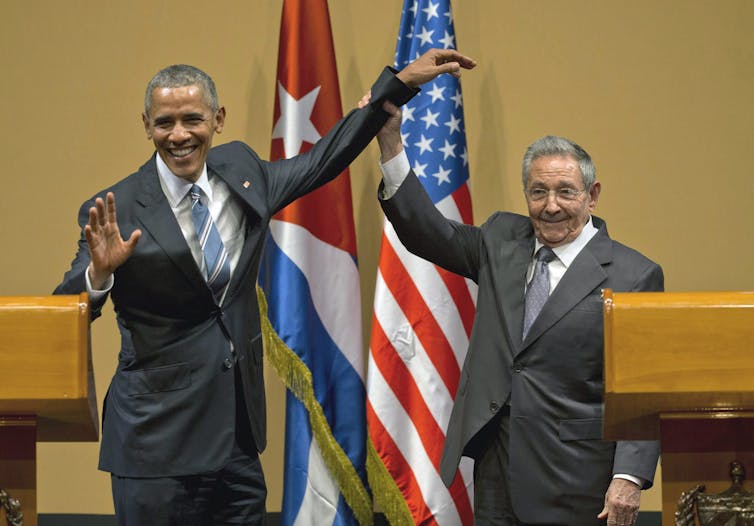 Cuban President Raul Castro, right, lifts up the arm of U.S. President Barack Obama, at the conclusion of their joint news conference in Havana, Cuba, in March 2016. It was the first visit by a sitting U.S. president to the island nation in 88 years. AP Photo/Ramon Espinosa, File)
Cuban doctors
For decades, Cuba relied on an elaborate network of international solidarity and co-operation with rich and poor countries alike. More than 100,000 Cuban doctors served abroad, often providing medical care in rural and remote locations.
While Cuban doctors working abroad received a salary bump, the government received handsome cash deposits and preferred trade agreements for select products. Venezuela received tens of thousands of Cuban doctors and, later, security personnel in exchange for heavy petroleum.
Read more: Big Pharma vs. Little Cuba: Why Cubans trust vaccines and how they’re helping vaccinate the world
Cuban doctors served in 103 countries, and as of 2021, they were active in 69 nations. Agreements were also made for other personnel to work abroad, including athletic coaches, teachers and engineers.
The U.S. targeted Cuba’s international solidarity work in 2006 by creating the Cuban Medical Professional Parole program, which essentially regarded Cuban workers as “trafficked.”
The State Department approved an annual US$10 million budget until 2017 to locate and recruit Cuban and Cuban-trained doctors working in poor areas of Latin America and Africa. Diplomats offered them expedited immigration to the U.S. But upon arrival, many had their medical credentials ignored and wound up unemployed or underemployed.
Global support
Against one of the longest economic blockades in history, Cuba has nonetheless positioned itself as an active global player. It’s a diplomatic heavyweight with 139 active embassies and consulates worldwide and well over 100 foreign embassies in Havana.
The United Nations General Assembly routinely denounces the American embargo on Cuba. In 2025, amid shifting political alliances, the assembly voted 165-7 in favour of demanding an end to the embargo.
Many international partnerships have kept Cuba going through hard times in the past. Canada, Italy and Mexico, in particular, have kept business with Cuba going despite the U.S. embargo. In the 1990s, tourism expanded, notably from these countries, helping to stimulate the Cuban economy.
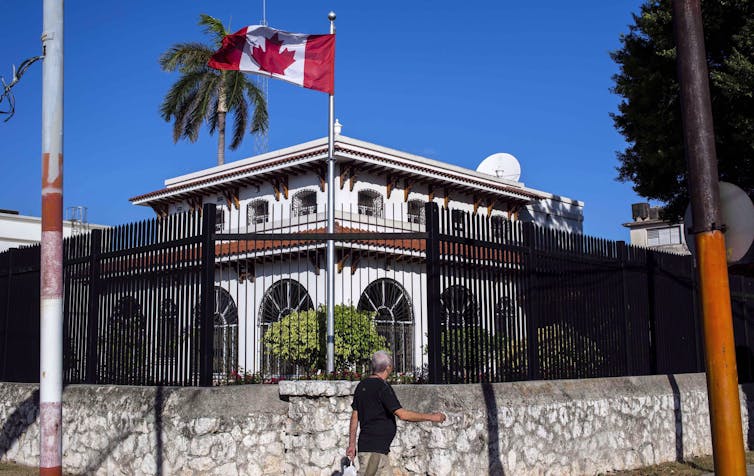 The Canadian embassy in Havana in 2018. THE CANADIAN PRESS
Canadian mining company Sherritt invested heavily in Cuba to extract nickel. When COVID-19 overwhelmed health systems worldwide in 2020, Cuba was the first to volunteer medical services to 19 countries, including affluent states like Italy and Qatar. They even took in a quarantined British cruise ship to offer care.
Read more: The scene from Cuba: How it’s getting so much right on COVID-19
But in 2026, countries are sending in aircraft to evacuate their vacationing nationals, and companies like Sherritt are grinding to a halt, not because of the U.S. embargo, but because so many professionally trained Cubans have emigrated.
Unlike the 1960s and the 1990s, no brave partners are coming forward to do business with Cuba, which only shows how weak international solidarity is today.
Here are three possible outcomes for Cuba in the coming months in descending order of likelihood:
1. Deals behind the scenes
A backroom deal could be struck between Trump’s White House and Miguel Díaz-Canal’s government in Cuba in much the same way that the Obama administration struck deals with Raúl Castro’s government, working through the Vatican and Canadian diplomats. For example, the Trump administration could permit fuel to be purchased in cash from the U.S., or more tourist real estate may be opened to foreign ownership.
If any deal is in the works, the sticking point will be elections. Unlike Venezuela, with a legitimate opposition in the wings, Cuba has none. Political opponents to the revolution have long been jailed or exiled, and Cuba’s electoral system itself isn’t structured for a multi-party race. Toppling the current government would leave an enormous power vacuum.
2. Martial law
If the fuel embargo remains, Cuba could declare martial law and civil defence to prepare for foreign hostility and to better ration resources.
Díaz-Canal recently hinted at this in what he calls a “war of the people,” which may help explain why Canadian and Russian airlines are now hastily sending in rescue flights for tourists.
Martial law would mean ultra-tight rationing, political volatility and the government acquiring goods through murky channels, which, combined, pose a heightened security risk to the U.S. just 140 kilometres off its shores. Since Dwight D. Eisenhower, most American presidents quickly figured out it was better to have a stable and secure, even though ideologically opposed, neighbour than a politically unstable and vulnerable basketcase.
The situation will grow dire since the well-educated professional class has already left, along with many doctors and nurses. In past crises, the educated, youthful professional class was on hand; this time, they’re already gone.
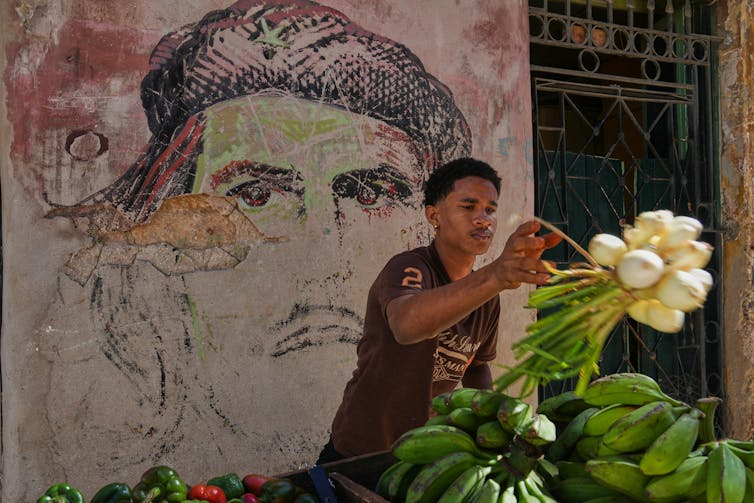 A vegetable vendor prepares onions for sale on his cart near an aged mural of Ernesto ‘Che’ Guevara in Old Havana, Cuba, in January 2026. (AP Photo/Ramon Espinosa)
3. The international community steps in
Third, the world could stand by its sentiment at the United Nations General Assembly and sends much-needed resources and trade to Cuba despite the U.S. bellicosity.
It could be a rallying point for the new era of international order, where bullied countries in the Americas and in Europe defy American pressure and bring lifelines to Cuba.
Read more: Mark Carney’s Davos speech marks a major departure from Canada’s usual approach to the U.S.
International solidarity could reverse some of the harm and take the pressure off Cubans, including those so desperate they’d choose to fight as mercenaries with Russia.
As the world has seen before, when nations stand up to Trump, he usually backs down. Assistance need not come through foreign aid, but simply by keeping the channels open for business.
But if the international community ignores Cuba today, a humanitarian nightmare will unfold soon.
Associate Professor in International Development Studies, Dalhousie University
Disclosure statement
Robert Huish receives funding from the Social Sciences and Humanities Research Council of Canada
Partners
View all partners
DOI
https://doi.org/10.64628/AAM.pvqhpjgdt
We believe in the free flow of information
Republish our articles for free, online or in print, under Creative Commons licence.Republish this article
If you’re planning on a winter break to Cuba, get ready for an adventure rather than a vacation. If you’re wondering if United States President Donald Trump’s oil embargo will shatter Cuba’s Communist government, dig in for a drawn-out slog. And if you’re Cuban, brace for a nightmare.
Cuba is on the brink of one of the worst social and economic catastrophes since the 1959 revolution. Energy sources are sparse. The electrical grid is in tatters.
Inflation is over 15 per cent, with the peso tumbling in value. Tropical diseases like dengue, chikunguny and Oropuche virus are surging, largely because the municipal waste system in Havana ground to a halt in 2025.
As many as two million Cubans have left the country since 2021. Infant mortality spiked from five per 1,000 live births in 2021 to 14 per 1,000 in late 2025.
And now, revenue streams from tourism, international medical co-operation and pharmaceutical production are all but dried up. Some 5,000 Cubans volunteered as mercenaries to fight alongside Russia against Ukraine since 2022. Cuba is hurting.
Drivers wait in line to fill up at a gas station in Havana, Cuba, Jan. 27, 2026. (AP Photo/Ramon Espinosa)The U.S. versus Cuba
Cuba’s current pain may not be enough to topple its Communist government, despite the desires of many Cuban exiles. Nor is the current crisis all Trump’s work. Cuba is a victim of the breakdown of the old international rules-based order.
Start your day with evidence-based news
Subscribe
This site is protected by reCAPTCHA and the Google Privacy Policy and Terms of Service apply.
Read more: Venezuela attack, Greenland threats and Gaza assault mark the collapse of international legal order
The U.S. has long targeted Cuba through various economic weapons dating from the early 1960s. One of the most vicious was the Helms-Burton Act that not only prohibited U.S. companies from doing business with Cuba, but also punished companies in other countries for dealing with both Cuba and the U.S.
In his second term, U.S. President Barack Obama eased travel restrictions for Americans visiting Cuba along with some trade policies, but this was short-lived. Trump restored these measures in his first administration.
Cuban President Raul Castro, right, lifts up the arm of U.S. President Barack Obama, at the conclusion of their joint news conference in Havana, Cuba, in March 2016. It was the first visit by a sitting U.S. president to the island nation in 88 years. AP Photo/Ramon Espinosa, File)Cuban doctors
For decades, Cuba relied on an elaborate network of international solidarity and co-operation with rich and poor countries alike. More than 100,000 Cuban doctors served abroad, often providing medical care in rural and remote locations.
While Cuban doctors working abroad received a salary bump, the government received handsome cash deposits and preferred trade agreements for select products. Venezuela received tens of thousands of Cuban doctors and, later, security personnel in exchange for heavy petroleum.
Read more: Big Pharma vs. Little Cuba: Why Cubans trust vaccines and how they’re helping vaccinate the world
Cuban doctors served in 103 countries, and as of 2021, they were active in 69 nations. Agreements were also made for other personnel to work abroad, including athletic coaches, teachers and engineers.
The U.S. targeted Cuba’s international solidarity work in 2006 by creating the Cuban Medical Professional Parole program, which essentially regarded Cuban workers as “trafficked.”
The State Department approved an annual US$10 million budget until 2017 to locate and recruit Cuban and Cuban-trained doctors working in poor areas of Latin America and Africa. Diplomats offered them expedited immigration to the U.S. But upon arrival, many had their medical credentials ignored and wound up unemployed or underemployed.
Global support
Against one of the longest economic blockades in history, Cuba has nonetheless positioned itself as an active global player. It’s a diplomatic heavyweight with 139 active embassies and consulates worldwide and well over 100 foreign embassies in Havana.
The United Nations General Assembly routinely denounces the American embargo on Cuba. In 2025, amid shifting political alliances, the assembly voted 165-7 in favour of demanding an end to the embargo.
Many international partnerships have kept Cuba going through hard times in the past. Canada, Italy and Mexico, in particular, have kept business with Cuba going despite the U.S. embargo. In the 1990s, tourism expanded, notably from these countries, helping to stimulate the Cuban economy.
The Canadian embassy in Havana in 2018. THE CANADIAN PRESSCanadian mining company Sherritt invested heavily in Cuba to extract nickel. When COVID-19 overwhelmed health systems worldwide in 2020, Cuba was the first to volunteer medical services to 19 countries, including affluent states like Italy and Qatar. They even took in a quarantined British cruise ship to offer care.
Read more: The scene from Cuba: How it’s getting so much right on COVID-19
But in 2026, countries are sending in aircraft to evacuate their vacationing nationals, and companies like Sherritt are grinding to a halt, not because of the U.S. embargo, but because so many professionally trained Cubans have emigrated.
Unlike the 1960s and the 1990s, no brave partners are coming forward to do business with Cuba, which only shows how weak international solidarity is today.
Here are three possible outcomes for Cuba in the coming months in descending order of likelihood:
1. Deals behind the scenes
A backroom deal could be struck between Trump’s White House and Miguel Díaz-Canal’s government in Cuba in much the same way that the Obama administration struck deals with Raúl Castro’s government, working through the Vatican and Canadian diplomats. For example, the Trump administration could permit fuel to be purchased in cash from the U.S., or more tourist real estate may be opened to foreign ownership.
If any deal is in the works, the sticking point will be elections. Unlike Venezuela, with a legitimate opposition in the wings, Cuba has none. Political opponents to the revolution have long been jailed or exiled, and Cuba’s electoral system itself isn’t structured for a multi-party race. Toppling the current government would leave an enormous power vacuum.
2. Martial law
If the fuel embargo remains, Cuba could declare martial law and civil defence to prepare for foreign hostility and to better ration resources.
Díaz-Canal recently hinted at this in what he calls a “war of the people,” which may help explain why Canadian and Russian airlines are now hastily sending in rescue flights for tourists.
Martial law would mean ultra-tight rationing, political volatility and the government acquiring goods through murky channels, which, combined, pose a heightened security risk to the U.S. just 140 kilometres off its shores. Since Dwight D. Eisenhower, most American presidents quickly figured out it was better to have a stable and secure, even though ideologically opposed, neighbour than a politically unstable and vulnerable basketcase.
The situation will grow dire since the well-educated professional class has already left, along with many doctors and nurses. In past crises, the educated, youthful professional class was on hand; this time, they’re already gone.
A vegetable vendor prepares onions for sale on his cart near an aged mural of Ernesto ‘Che’ Guevara in Old Havana, Cuba, in January 2026. (AP Photo/Ramon Espinosa)3. The international community steps in
Third, the world could stand by its sentiment at the United Nations General Assembly and sends much-needed resources and trade to Cuba despite the U.S. bellicosity.
It could be a rallying point for the new era of international order, where bullied countries in the Americas and in Europe defy American pressure and bring lifelines to Cuba.
Read more: Mark Carney’s Davos speech marks a major departure from Canada’s usual approach to the U.S.
International solidarity could reverse some of the harm and take the pressure off Cubans, including those so desperate they’d choose to fight as mercenaries with Russia.
As the world has seen before, when nations stand up to Trump, he usually backs down. Assistance need not come through foreign aid, but simply by keeping the channels open for business.
But if the international community ignores Cuba today, a humanitarian nightmare will unfold soon.
The AI warnings are coming from inside the house

Shannon May
It’s as if a bunch of AI experts just had the same nightmare, because this week, several of them—including ones at Anthropic and OpenAI—seemingly jolted upright in a cold sweat to speak on the horrors they see coming from artificial intelligence. Anthropic: The company behind Claude lost its head of Safeguards Research, who announced his resignation in a letter that mentioned a world “in peril.” Speaking vaguely about Anthropic, he wrote, “Throughout my time here, I’ve repeatedly seen how hard it is to truly let our values govern our actions…we constantly face pressures to set aside what matters most.” At OpenAI, alarm bells came from three different employees this week:
HyperWrite: The co-founder of an AI writing tool startup warned in a viral post on X that the latest AI models will render countless jobs obsolete, comparing the current moment to the weeks before the Covid-19 pandemic. How about some AI restrictions for the table?OpenAI and Anthropic are of two minds on how much to regulate their industry:
Meanwhile…half of xAI’s founders have exited as of this week, though the recent departures didn’t specifically cite AI concerns. |
Quebec upholds tuition hikes as Concordia braces for deeper budget cuts
Quebec upholds tuition hikes as Concordia braces for deeper budget cuts
Students, universities warn higher fees increase financial pressures and lower enrolment
NewsMatthew Daldalian — Published February 10, 2026 minutes
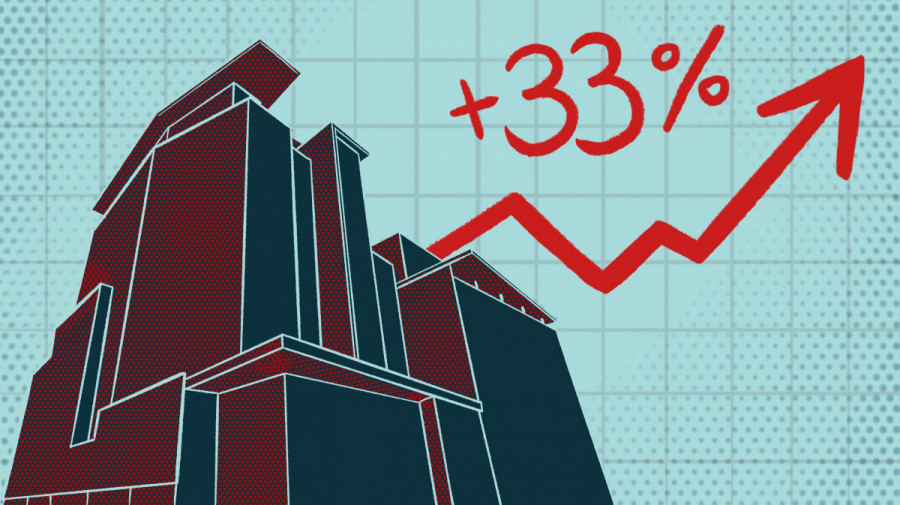 Quebec is maintaining a 33 per cent tuition hike for out-of-province students attending English-language universities. photo Naya Hachwa
The Quebec government is maintaining the tuition hikes for out-of-province students attending English-language universities, confirming that the increased fees will remain in place following the province’s revised funding framework.
The decision preserves a roughly 33 per cent increase that raised the minimum tuition for out-of-province Canadian students studying in English to about $12,000 annually, up from $9,000 in Winter 2024.
“When I was applying to come here, it was my first choice, but because of the tuition hikes, it made me reconsider everything,” said Kalia Graham, a second-year psychology student at Concordia University, originally from Whitehorse, Yukon. “I almost didn’t end up coming.”
The tuition hike was first announced in October 2023 as part of a broader overhaul of Quebec’s university funding system targeting English-language institutions.
English universities initially challenged the increase in court. However, the province has since updated its rationale, arguing that the increase prevents Quebec taxpayers from subsidizing the education of non-resident students.
“I had to really discuss budgeting with my family and plan it out to see how it would look,” Graham said.
Graham added that two of her friends who had also planned to attend university in Montreal ultimately chose not to because of the tuition increases.
These provincial policy changes have also had institutional consequences. Concordia and McGill University previously argued in court that the tuition overhaul harmed their competitiveness and contributed to declining out-of-province applications, forcing budget adjustments and service reductions.
According to remarks delivered during recent Concordia Senate discussions on Feb. 6, the government has now formally entrenched the higher fee, arguing that it is “not fair for the taxpayers of Quebec to be subsidizing the cost of educating students from elsewhere.”
“There comes a point where you get used to the fact that people consider you to be the easy scapegoat.”— Thang Tran, international student
Senate discussions also noted that students studying in French-language programs continue to pay the lower rate, meaning the financial impact disproportionately affects English-language institutions.
Ryan Assaker, finance coordinator for the Concordia Student Union, said the consequences are already visible on campus.
“We’ve seen trends here where the free food programs that we have are having bigger lines," Assaker said, pointing to increased demand for student services. "The housing [services], or all of our service departments, are also ranking up.”
Financial strain is also reflected in campus reductions, Assaker said, including cuts to limited-term appointment teaching positions—short-term instructors hired to teach specific courses—as well as reduced shuttle-bus service between campuses.
Assaker added that declining international enrolment could have long-term effects on programming and staffing.
“The incentive isn’t there anymore," he said. "It’s costing too much."
For students already enrolled, the issue is not only future costs but also uncertainty about how policies apply.
Senate discussions have highlighted concerns that some out-of-province students who switch programs risk losing their original tuition status, potentially facing the higher rate even if they began their studies before the policy took effect.
Adam Semergian, academic coordinator for the Arts and Science Federation of Associations, said student groups are already hearing concerns about enrolment decisions.
“We’ve heard from current students that their family members [...] are not planning to come to Concordia now because of the tuition hike,” Semergian said. “It’s 33 per cent now, but what about in the future?”
Despite the higher costs, some students say they remain committed to continuing their studies in Montreal while navigating financial pressures.
Graham said her budgeting now depends on summer work, grants and loans, adding that she typically works multiple jobs during the summer months to cover expenses.
International students face similar challenges. Thang Tran, a first-year computer science student from Vietnam, said he has grown accustomed to the idea of higher fees but still feels the policy's financial and political implications.
“There comes a point where you get used to the fact that people consider you to be the easy scapegoat,” Tran said.
He added that as a non-citizen, he feels he has limited power to fight back against decisions affecting tuition.
The latest decision primarily confirms the 33 per cent tuition increase for out-of-province Canadian students; it does not affect international students.
However, this comes at a time when international students are already affected by earlier reforms that raised minimum tuition levels for English universities in Quebec.
In the meantime, university officials say they will continue raising concerns with the province.
In a written statement, Concordia deputy spokesperson Julie Fortier said the institution is “of course disappointed by the decision but not surprised,” adding that the university plans to discuss with Higher Education Minister Martine Biron how the policy harms the competitiveness of Quebec universities and contributes to declining applications.
Fortier noted the university continues to offer financial awards to help offset the higher tuition for out-of-province students.
For students like Graham, entrance scholarships and student-run services have helped ease the transition, although financial planning remains a constant concern.
For Tran, the issue ultimately comes down to the limited control many international students feel they have over policies that directly shape their education.
“There isn’t much I can do. I can’t really engage with democracy in a way that citizens can,” Tran said. “All I can do is tell my friends, 'Well, if you don’t like it, you should vote.'”
With files from Moon Jinseok
Subscribe to:
Posts (Atom)